Europe doesn't have a culture of throwing illimitate money at startups with little hope of getting anything back. Which is probably due to not having petrodollars.
It will make very little difference if Wall Street investors hold very little property.
Putting a finger on the scale of how much real estate is individually owned definitely makes a difference though. It makes it worse.
100,000 individuals who own 100,000 properties have far more political power than 10 companies who own 100,000 properties.
>If you want housing to be cheaper and renters to be better treated, increase supply. Everything else is window-dressing.
Yes. However supply is artificially restricted by government, to the approval of the average property owning voter. So more specifically, that is what needs to be changed. Everything else is window-dressing.
This is a country sliding further towards being us, with their housing being more restricted and more expensive.
100,000 votes (and really probably closer to 150,000 influenceable votes across those households) is a significant number compared to 10 companies who own an average of 10,000 properties each, yes.
Companies with tremendous wealth manipulate voters and lobby their representatives. Don’t presume that voters are remotely well-informed of who backs their interests.
Consider every other expense that people have that's supplied by companies (see: literally everything). Why have those companies not successfully lobbied to prevent competition? Industries where it happens are the exception, not the rule.
What's their basis for sending the emails then? If not one of legal standing in copyright/contract law?
Edit: My point is this is just another one of many annoying people you have to deal with who will email you alleging all sorts of legal violations, who don't themselves understand anything about the claims they are making.
Sure, I understand that there's a difference. That's why I sought clarification.
My understanding of the concept of "basis" does not fit the context of sending an email, and "reason" is the closest I can find that fits.
Basis being concerned with rules or authority. The assumption being when asking "what is the basis for X?" that there was a bar that needed to be met beyond the doers motivations. That there needed to be more than they wanted to. Which of course, does not apply to sending an email. I could email you right now asking you what your favourite type of fish is or seeing if you want to play a game of chess, no basis needed. I'd just need a reason to.
Poorly explained maybe but it covers not just that there is no basis but that no basis is needed and draws attention to the odd request for a basis where none is needed.
Just "there is no basis" as a response would be like saying "yes" or "no" to "have you stopped beating your wife?"
We're talking about Lost-Entrepreneur439 on Reddit emailing a company to ask for some of their code.
You can just do that. No GPL, open source, enforcement, demands, etc language needed. Just "I'm trying to do X, can I see the code for Y?". I receive and send them at work pretty frequently.
They've mentioned the GPL as a way to try to increase the chances of getting sent the code. A support person for a medical device company might not know anything about software licences or linux or GPL. If the company has some sort of "send GPL code to askers" policy and Lost-Entrepreneur439 just asks for the linux kernel, the support person might not know that the GPL policy applies and just say no. If you include it in your message then it increases the chances of them typing "GPL" in to whatever internal knowledge bank they have and seeing "for GPL requests, forward the enquiry to jeff@ourcompany.com" or something like that.
The GPL isn't between Lost-Entrepreneur439 and the company so I don't think "enforcement/exercising a legal right" is an accurate way to describe what we're talking about. That would be if the copyright holders to the linux kernel get involved.
EDIT:
Although that seems like largely just a semantics thing. Like if a judge orders a company to pay you some money and you say "give it to austhrow743" is it valid to say that I have a right to that money? Or is it that you have the right that I get that money? If someone wants to phrase "linux kernel copyright holders have a right to demand users of their code share it with anyone who asks" as "anyone who asks has a right to that code" then I don't really have a problem with that.
I just see a big difference between making a request and making a claim. I don't need to think I'm legally entitled to something to ask for it. I don't even need to think that getting it is likely. Whereas Abigail appears to be treating sending and receiving requests by emails as equivalent to a court summons.
And now we get to my question of why. They want the Linux source code, the company is not giving it to them, why is the next step a blog post instead of a lawsuit? Again this is a medical device - it's important enough to spend the money on.
They make a blog post about GPL violations which allege the company is violating the law.
I'm absolutely begging for anyone in a similar situation to prove it. The reasons those emails were sent is because they think they have a legal entitlement to be sent the source code. *PROVE IT*. It's cheap!
Their Google dependency is their existential problem. They're limited by what they can do with "making Firefox better" while effectively being a client state. An off the books Google department. Doomed to forever being a worse funded Chrome because they can't do too much to anger their patron.
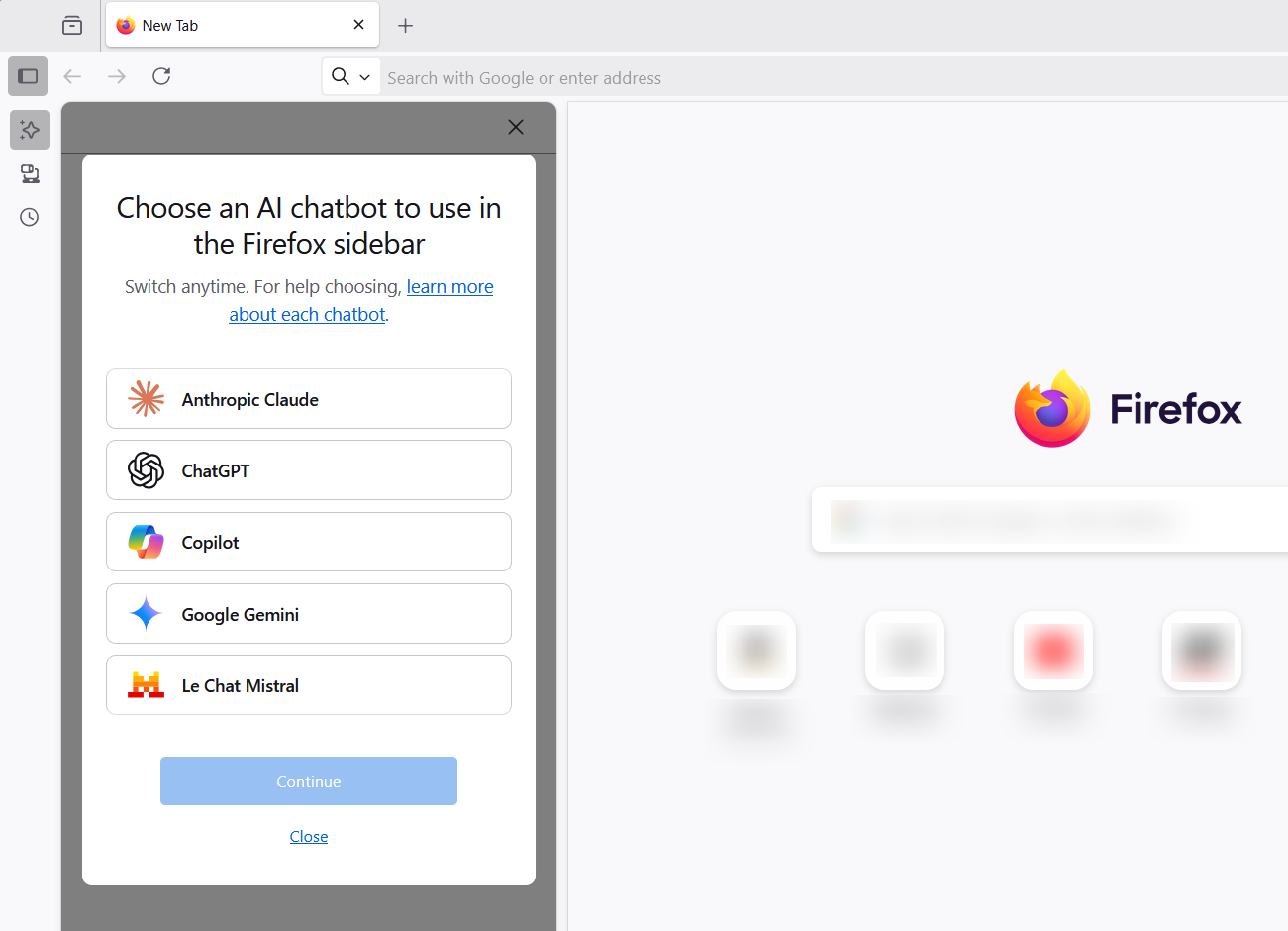
By selling browser UI real estate to AI companies[0] they reduce the power Google has over them. If they get to the point where no individual company makes up a majority of their revenue, it allows them to focus on their mission in a much broader way.
Yeah but is this entirely true though? It seems Google pays FF just for existing, to protect them from antitrust litigation (or what's left of it); so Google can't really stop paying FF and can't try to kill it, as its death would be extremely counter productive. FF may be freer than it thinks.
Same as for Apple, the amount Google pays will vary. Firefox will probably still exist with 10% of Google's money, except execs Mozilla execs would be in a very different situation.
Its not impossible that someday a new non-chromium browser reaches feature parity (or close enough) with the chromium browsers. At that point, Google could stop worrying about funding Firefox's development.
Google pay Mozilla hundreds of millions of dollars each year to place Google as the default browser. It's by far their biggest income stream. In 2023 it was reported as 75% of their revenue.
There's no world in which 75% of your revenue coming from Google doesn't influence what you do. Even if it's not the main driver of all decisions, pissing off Google is a huge risk for them.
If the plaintiff pays 500 million to the judge and the defendant goes to jail, there's no proof that the judge wouldn't have made the same decision without the 500 million. If you're a fool, you'll sneer and ask "Where's the proof?"
Well if you bring up law how about: innocent until proven guilty?
Google is not bribing Mozilla...they probably keep them alive to avoid all kinds of monopoly lawsuits. With their market share however, you would need more prove to justify further conspiracies...
The new AI Tab Grouping feature says it. I've never tried the AI chatbot feature but that makes sense. Would be fun to somehow talk to the local AI translation feature.
We've been having trouble telling if people are using the same product ever since Chat GPT first got popular. The had a free model and a paid model, that was it, no other competitors or naming schemes to worry about, and discussions were still full of people talking about current capabilities without saying what model they were using.
For me, "gemini" currently means using this model in the llm.datasette.io cli tool.
openrouter/google/gemini-3-pro-preview
For what anyone else means? If they're equivalent? If Google does something different when you use "Gemini 3" in their browser app vs their cli app vs plans vs api users vs third party api users? No idea to any of the above.
World in Conflict was an interesting take on making RTS easier for casuals. Basically took the resource gathering part out of it. You got a constant drip of points you could spend on units instead.
Potentially that simplification hurts the genre too much though because then you don't have hardcore players sticking with it for years and years.
Maybe a game could have that as a "simple mode" that players can opt in to.
The potential addictive money making pattern is the same as other games imo. Skins. The units being smaller mean the developer is probably going to have to go to more effort to shove them in to peoples faces. Maybe a screen before/after the match where all the players units in their skins can be clear seen in a more zoomed in manner. Have them marching around the border of the end scoresheet or doing a little dance while waiting for players to load.


reply