Why shouldn’t cyclists need a license to ride on the road? Others road users must have one.
----
It's a shame I'm getting downvoted, but the current state of affairs is that in cities like London bicycles, cars and trucks will be sharing the road for the near-mid future.
I'd rather not have trucks or cars in the city, and ideally cyclists would have their own road separate from cars and pedestrians, but I think that's a pipe dream.
Until then what else can do we? At least if we require tests for cyclists, like we do for cars, buses and trucks, it might help reduce the number of cyclists doing risky things that perhaps they aren't even aware of?
Sure there are still reckless drivers, but at least they have a license that can be revoked and points that can be fined. How do we ban reckless cyclists from the road?
> Why shouldn’t cyclists need a license to ride on the road?
Thought experiment: if you didn't have any motorised vehicles on the road, would you still want cyclists to have a licence?
In a general case though, requiring cyclists to have a licence would reduce the number of cyclists, probably significantly. This would correspondingly increase the number of motorists.
This dual effect would have a number of negative impacts. More motorists lead to more congestion, more CO2 emitted and poorer air quality. Poorer air quality leads to health problems, up to and including deaths. CO2 causes climate change, and greater congestion has an economic impact. Fewer people cycling mean fewer people getting exercise, leading to more health problems, up to and including deaths.
I'm confident these problems would overshadow the small improvements in cyclist safety you might gain with a cycling licence requirement. There are better ways to improve cycling safety.
> Thought experiment: if you didn't have any motorised vehicles on the road, would you still want cyclists to have a licence?
Of course! In a world where there were only cyclists there would still need to be a set of rules that all cyclists are required to follow. Those might include how to behave at intersections, how and when you should overtake other cyclists, and so on. To be allowed to cycle, each cyclist should have demonstrated that they understand and follow these rules by taking some kind of test.
> In a general case though, requiring cyclists to have a licence would reduce the number of cyclists, probably significantly. This would correspondingly increase the number of motorists.
I don't think so. I expect the government to continue to penalize use of motor vehicles in cities such as London. The bicycle will remain the cheaper mode of transport.
I don't. In the United States, bicyclists must follow largely the same rules of the road that drivers of motor vehicles must follow. They can even be ticketed for violating those rules although usually the tickets don't have much in the way of teeth (except things like DUI while biking).
Here in the Bay Area, it's a rare bicyclist that actually follows the rules. Talking to other bicyclists, I've found a large number of them are simply ignorant to the fact that the rules apply to them as well; or they have adopted some bizarre version of the rules or a sense of entitlement.
I could talk anecdotes for hours, but one particularly egregious example is a bicyclist who showed up to a 4-way stop after I was already moving through the intersection, cut through my path, and gave me the finger, all without even slowing down, much less stopping.
Requiring bicyclists to pass at least a basic test would go a long way towards clearing things up or at least changing the "bicyclists don't have to follow the rules" culture that exists here, making the roads safer for themselves, walkers/runners, and drivers alike.
Forcing bicycles to follow rules designed for cars is often silly and sometimes actively dangerous. For example, the bike route from downtown to my house involves making a left turn on a busy street. For a mile and a half, the street is nice and wide, with generous bike lanes in both directions - sensible and safe. But the moment I have to turn left? By car laws, I need to stop in the middle of the road, with traffic coming up behind me (often at 40+mph), and wait until I have a clear path to turn left, which can take a while. This is deadly.
So I do the illegal. I turn right on the quiet side street and immediately u-turn to the stop sign, to wait to cross both sides. It's not a dangerous maneuver for me or anyone else, although it would be dangerous for a car to do so.
See the problem?
edit: A car waiting to turn left is in considerably less danger. It's much easier for traffic coming from behind to see, so it's less likely to be hit. And if it is hit, the driver is protected by the car itself. At worst, the car gets totaled. But a bicycle hit at 40mph? The cyclist is likely going to be killed. It's not just silly to follow the car law - it's hazardous.
I think one the purposes of traffic law is to make the behavior of all participants predictable. My only issue with cyclists is I feel I can never predict what they're going to do.
There's usually laws about how far you can see, how far you have to be from an intersection etc.
"My only issue with cyclists is I feel I can never predict what they're going to do."
This is not entirely the fault of the cyclists, it's the fault of the law givers
The laws are not written in such a way that it appears safe to people using bikes to follow all the rules, so everyone is compelled to come up with their own rules. The build of roads is the same; a small detour for a person in a car can become quite substantial for a person on a bike.
At the moment the laws get written and the roads get design assuming almost everyone is going to use a car, and then they say "well, is it physically possible to follow it on a bike?" - if they consider bikes at all.
If governments wanted people to ride bikes predictably, they must consider them when crafting the laws. It's probably quite okay for people riding bikes to act differently than people driving cars: just like people walking around behave differently. It will then take some time to spread the word and regain the trust of cyclists. But it's a more helpful solution than saying "they must follow rules and infrastructure designed for cars in the same way as cars, except that they must not delay me: that way they will be predictable and safe".
Depends on the local law. In some cities, this is bike-legal, and even officially encouraged as "indirect left turn": see the side-street bike box, intended just for this: on your green, you cross the side street, turn right-then-left into the box and wait for a green signal to cross the main road. https://prahounakole.cz/wp-content/pnk/uploads/2013/03/pruhy...
Your u-turn sounds legal, even in a car, but I'd have to see the area and know the state to be sure. Regardless, bicyclists are already required to follow the law. Having a required license would simply help make sure bicyclists are aware of the law and provide a tool for law enforcement to keep the most egregious offenders (e.g. stop sign runners, cyclists traveling against traffic, etc.) from causing problems.
Why? Requiring a license doesn't seem to make car drivers any better. And most bicyclists already have a driver's license. Those who don't tend to be kids, or poor (having a driver's license is privilege, although a common one). Forcing them to need a license will just create more illegal bicyclists.
Law enforcement can already ticket a bicyclist, license or no license. Bicyclists already know when they're breaking the law.
I disbelieve your proposed solution would actually solve any problems.
> Why? Requiring a license doesn't seem to make car drivers any better.
Then let's advocate for getting rid of licensing since it has a cost and no benefit. I don't think you really mean that, do you? I've got plenty of ideas for a better licensing system for driving.
> Forcing them to need a license will just create more illegal bicyclists.
Illegal drivers face consequences that licensed drivers do not face. The same would be true for illegal bicyclists. I fail to see this as a bad thing.
> Bicyclists already know when they're breaking the law.
They don't know. They might know if they did it in a car they would be breaking the law. They also believe themselves to be incapable of creating a dangerous situation. (Quick anecdote: I was on a jury for a civil case where a bicyclist admitted on the stand he ran into a car that, by all evidence and even his own testimony, was stopped. The bicyclist had also run a stop sign. He felt the driver was at fault for the accident.)
Being a bicyclist myself, I assumed everyone knew as well. Back home, all my cycling friends knew and followed the rules. When I started cycling with people here, I found out they really don't know that the rules apply to them, they think the rules are different in some way, or they just have some really bizarre notions. AFAICT, it's baked into the culture. I mean, people don't know basic stuff like that you can get a DUI on a bike or that you can't ride on the sidewalk...
A bicycle-specific license (or maybe an endorsement on a DL) could focus on bicycle-specific issues, with basic questions like "I have to stop for a stop sign on a bicycle. T/F" and more 'complex' stuff like how bicycle lanes work at intersections with people making right turns. Drivers and cyclists alike seem to have no clue that the driver should enter the bicycle lane (after yielding to bicycles in the lane) for his turn and that the bicyclist should not try to pass him on the right.
Not sure where that is - out here (central Europe) the examples like "no DUI or sidewalks allowed" are known almost universally. Of course, knowledge won't stop you - a completely drunk (0.2 BAC) driver just killed a pedestrian a few days ago: he knew it was blatantly illegal, had a valid driver's license to certify that, but went out for a drive just the same.
It's a rare driver that actually follows the rules. Speed limits are almost never followed. I frequently see drivers go through a light that has already turned red, roll through a stop sign without fully stopping or come dangerously close to hitting a pedestrian to whom they were supposed to yield the right of way.
Drivers routinely kill other drivers or pedestrians through carelessness. Few if any cyclists ever kill someone else. If anything we need more rigorous tests for drivers, not for cyclists.
What I loathe most about cyclists as a pedestrian, (I am also a cyclist and also a driver) is when they ignore pedestrians crossing a street and simply swerve between people --at speed. Kids are unpredictable and they don't have the same sense as adults, yet, I've had prickish cyclists ride on through as if nothing.
In a world where there were only pedestrians, would you want them to start having licences? Per mile, walking is exceedingly dangerous compared to other modes of transport.
1. Pedestrians move at much slower speeds than bicycles. If two pedestrians walk into each at 5mph the damage is much lower than if two cyclists collide at 30mph.
2. Since pedestrians move much slower than bicycles they can manoeuvre much faster. The stopping distance for a walking pedestrian is less than 1m, the stopping distance for a bycicle travelling at 30mph is much greater.
3. If two pedestrians walk into each other the chance of collateral damage is quite low. It's quite easy to walk around two people that just walked into each other.
If two cyclists collide, there is a good chance that cyclists on each side of them will get caught up in the collision, crash and injure themselves too. A good example of this are the crashes seen on Tour de France.
Of course, if people started running as a mode of transport it would become increasingly dangerous, and you'd have to start separating the walkers from the runners as the damage from a potential collision would be much greater.
> A good example of this are the crashes seen on Tour de France.
Basing rules for cyclists on the Tour de France is like basing rules for automobiles on F1 or Nascar. Normal commuters just don't reach anything close to Tour de France speeds. Most would be lucky to even maintain a third of that speed without the help of a hill.
Most commuters will be going about 10 mph. Even getting hit with a car at that speed will only cause an injury at all about 25% of the time, a serious injury about 15% of the time and is almost never fatal[1]. A bicycle will barely do anything at that speed.
By all means add special rules for using bicycles at unusually high speeds, but don't act like normal commuters are going to be going that speed.
Ok, so licences for runners then, as you may need to have a test to see that people know the rules and presumably ban people from running if they break them.
Since running is largely recreational most runners avoid congested areas on purpose. If this changes it will have to be revisited. Nice strawman though.
Was trying more for reducto ad absurdum. I didn't come up with the idea of having laws to separate runners from walkers, you did. I was just exploring the enforcement mechanism for such a suggestion.
Well I think the issue is that unlike the pavement, the roads are much more stringently regulated with sign posts, markings and lights.
For as long as cyclists have to cycle on the roads as we know them a cyclist should be required to demonstrate that they understand the signs and rules of the road. That could be by presenting their official drivers license, or, should they not have one, be required to take a theory test. I think that would be a sensible first step.
You could then imagine a practical test for hazard perception, efficient use of gearing and safe filtering through queues of traffic.
Naturally, people don't walk on the road, and pavements don't have the same kind of mandatory control flow unless they intersect with the road, and most children are taught how to cross the road from a young age.
I walk on the road all the time, having grown up in an area with plenty of rural roads without pavements.
I would get into a ton of shit should I visit anywhere that had jaywalking laws, though in the places they exist and are enforced, they presumably get by without a dedicated licensing and testing regime.
Dude, you're missing the point. You do not walk on the road the same way a cyclist cycles on the road. You do not walk up to T junctions, indicate with your arms and turn left. You neither come to a set of traffic lights in the same way. Cyclists have to do all these things.
And they are somehow managing to do so currently without licences.
One thing to consider is how much effect licensing has on car safety anyway. Mexico city has no test requirement at all, you just pay for permission to drive rather than sitting any test, while Peru has more road deaths per capita, despite needing a practical test, written test and medical certificate before you get behind the wheel.
In so many discussions on HN I see this silly myth of 30mph bicycles.
Did you know that in Sweden, the legal maximum speed of a electric bike is 15mph? Anything faster and it is classified as a moped and you need a driving license. Did you also know that the average speed of a bike in a city in the Netherlands is around 9mph? In context, a common running speed is 8mph.
So here is the stage. Two bikes are traveling more than 300% faster than the average speed and about 200% the legal limit of a electric bike, and they collide. My question would not be if that situation is safer if two pedestrians walk into each other, but rather why two bikes is traveling that fast in the first place.
Not all cyclist ride one speed "gentleman/lady" bikes. Many travel upto 30mph. That's a safety concern. There have been a number of cases of cyclists running over pedestrians resulting in serious injury, so it's not inconceivable to require licensing.
Licensing doesn't stop people driving cars from charging into others, killing them. It's not going to stop bike riders who are inclined to drive with such recklessness that they endanger their own life from driving with that recklessness
> In a general case though, requiring cyclists to have a licence would reduce the number of cyclists, probably significantly. This would correspondingly increase the number of motorists.
Most cyclists are licensed drivers, and a test for cycling licensing would, at worst, probably be no more difficult than that for driving. The impact on the number of cyclists would be minimal.
A bicycle can injure or kill a pedestrian or cause a motor vehicle accident. What is the justification for licensing motor vehicle driving but not bicycling when done on public roads? I cannot think of anyone who fails a motor vehicle licensing test that I consider competent to not cause others harm while operating a bicycle on public roads. I would much rather suffer the 'dangers' of increased carpooling or public transit use.
No, they are not. Atleast outside the US they're not. I know a significant number of people, myself included, who are experienced cyclists who have never driven a car in their life. Cycling is far more common in urban areas where driving is impractical or amongst young people who can't afford or don't want to drive.
You are correct in pointing out that it doesn't have much to do with the rest of my argument. I posed it as a question because I think a lot of the opinions around this issue (like many or most issues) stem from emotions. In this case I think this argument comes from a sense of fairness: motorists have to pay tax / have insurance / pass a test; so why shouldn't cyclists? I think if you consider whether we would even be asking that question if there were no motorists, you can get around the "fairness" point of view.
Interesting. I wasn't coming from that angle. I think cycling would be less risky if there weren't cars on the road, so I would see less of a reason to have cyclists take a test and get a license if they didn't have to mix with auto traffic.
Requiring licensing for cyclists could indirectly result in more deaths depending on the change in other behaviours.
Off the top of my head, walking is more risky per mile for the traveller than cycling while driving is safer per mile, but increases your risk of obesity and DVT and is more dangerous for everyone else in terms of pollution and accidents.
> Until then what else can do we? At least if we require tests for cyclists, like we do for cars, buses and trucks, it might help reduce the number of cyclists doing risky things that perhaps they aren't even aware of?
Statistics show that in the large majority of cases of accidents between cycles and motor vehicles, the driver of the motor vehicle is at fault. Requiring a license for cycles will do just about nothing to fix this. Just yesterday I was nearly run over by a car turning left into the oncoming cycle lane and by another one who thought that the pedestrians traffic light applies to bicycles. My knowledge that I was correct in both cases did not help the least bit.
So maybe yearly retraining for drivers of motor vehicles would be a better move.
>Statistics show that in the large majority of cases of accidents between cycles and motor vehicles, the driver of the motor vehicle is at fault. Requiring a license for cycles will do just about nothing to fix this.
As a regular cyclist, I would say that requiring a license from cyclists would certainly do something to fix this: make cyclists more aware of it.
Over here, about 2/3 of collisions between motor vehicle and bicycle are fault of the motor vehicle driver. But that leaves 1/3 where cyclist errors or breaches of traffic code are reason, which is also significant.
And then there are actually quite many cyclist accidents that do not involve a motor vehicle.
> Over here, about 2/3 of collisions between motor vehicle and bicycle are fault of the motor vehicle driver. But that leaves 1/3 where cyclist errors or breaches of traffic code are reason, which is also significant.
You are assuming that this 1/3rd is due to lack of knowledge - I question that assertion. And still, regular retraining of motor vehicle drivers would still be a better investment. They choose to move a ton of steel around in a manner that's potentially dangerous to others and they cause twice as many accidents, despite having a license requirement.
> And then there are actually quite many cyclist accidents that do not involve a motor vehicle.
Those tend to be less severe. Last years stats for Berlin: All cyclists killed were killed in an accident with a motor vehicle. Most common causes: dooring, right turn accidents, mostly trucks, one cyclist running a red light.
Likewise, that 2/3 is mostly not due to lack of knowledge. Over here (Finland), driving license training and testing nowadays has increased "attitude" training, as that is seen becoming more important than knowledge of traffic rules etc.
Here, a motor vehicle was involved in 62 % of all bicyclist deaths over the period 2011-2015 (116 cases). Motor vehicle was not the guilty party in all of those (but in roughly 2/3 of them). So, motor vehicle driver was at fault in about 40 % of cyclist deaths.
> So, motor vehicle driver was at fault in about 40 % of cyclist deaths.
Without any breakdown of who was at fault in the other accidents your stats still indicate that in comparison between bikes and motor vehicles, motor vehicle drivers are still twice as likely to be at fault. Retrain them before you retrain cyclists.
In a large majority of the remaining cases it is the cyclists who is at fault. There are a few cases where a pedestrian causes a cyclist death, but they are rare. The list includes those cyclists who are run over by a train, for instance, but we don't really expect trains to swerve to avoid cyclists, and such a collision is the cyclist's fault.
I don't necessarily say that requiring a license from cyclists is what I want. However, I do think that some training and education of cyclists would certainly help. I also see some cyclists who have clear attitude problems. So retraining - or perhaps re-orienting - everyone would help.
Because it’s an inefficient use of time and money. All that you’ll achieve is less people cycling and that’s exactly the opposite of what you want. Think about the practicality of a cycle license: do you expect a 6 year old to pass a test before cycling? A ten year old to carry along a license when he goes out? You can’t even fine them because the statuary limit in germany is 14. You can’t fine the parents either because parents are not obliged to keep their kids in sight all the time. Adults are already very likely to have a drivers license, should they now need a cycling license on top.
So make better use of the time and money: create safe infrastructure or - as a better investment train those that already have a license requirement and that insist on moving around tons of steel. Maybe increase the number of hours in school that deal with safe conduct in traffic. Or - gasp - fine the people blocking cycle lanes and otherwise endangering cyclist hard.
So the conclusion here is that cycling is fine just how it is, based on a cost/benefit analysis, and that motor car users need to be regularly examined and educated to ensure good road safety for everyone?
no, that's not the conclusion. I didn't bring up the "let's have a license requirement for cyclists idea." My point is that this is not a change that would improve cycling in a way that outweighs the negative effects. It's a bullshit idea that gets floated from time to time.
Improve cycling by all means, but use something that is effective: better infrastructure, education, enforcement. The Berlin police introduced a police squad on cycles a few years ago in one district and that has proven to be a very effective method: For one, they enforce road rules for people on bicyclist, but the major effect is that they remove cars from infrastructure dedicated to bicycles which in turn actually enables cyclists to use that infrastructure and makes people less likely to ride on the sidewalk, for example.
No, not in this case. It's not like people don't know the rules and the majority of people get killed despite being absolutely in the right and having done nothing wrong. How do you fix that with education? The dooring accident that nearly killed me happened on a cycle lane that I was by law required to use. The car driver just opened the door into the oncoming cycle traffic. How could you educate me better in a way that would have prevented me from making a hard impact with that door? Witnesses told me they didn't even expect me to get up again. How would educating me help prevent the three close passes I had today, especially the one where the car driver thought I'd have to squeeze into the dooring zone? The one that passed me when I was doing 30 in a max 30 zone? The close pass yesterday where the car driver didn't manage to pass me before the oncoming traffic was there, squeezing me against the parked cars? I was in the right, still I'd be the one dead. Should I yield and crawl? Cycling isn't a sport for me, it's my preferred mode of transport, I really want to get somewhere and I don't want to spend ages doing so.
Calling for education of cyclists has a strong smell of victim blaming. Oh, sorry, he's dead. If he'd been better educated, he might have known that he was in the right.
Because, while it does occasionally happen, the risk of a cyclist killing or seriously injuring another road user is much lower than the risk of a car driver doing so. Unlicensed cyclists are a much lower risk to other road users than licensed drivers; if anything we should be looking to impose stricter licensing requirements on drivers.
They're still a risk. Not knowing the rules can cause a motorist who did absolutely nothing wrong to kill said cyclist or swerve away from the cyclist and kill someone else not even involved, all because of a negligent cyclist.
That said, demanding a license for cyclists I agree is completely unreasonable.
In my country all school children are taught the rules of the road at traffic school where they ride their bikes around a miniature road layout that comprises of most road scenarios.
What is the actual gain to society from requiring a cyclist license? Today, without licenses, police can and do hand out moving violations to cyclists. Today, drivers who have their license revoked or car impounded still find ways to drive cars, at least in the US. The barrier to picking up a new bike after having yours impounded by police is far lower. If it's forcing a baseline requirement for skills and knowledge, well we've already seen how well that's worked out for drivers (most drivers suck at it).
Licensing cyclists seems like a feel good idea to make things "fair". The fact is, things can never be fair between to such disparate classes of vehicles. Can someone explain how a world with licensed cyclists would be fundamentally different than today?
> What is the actual gain to society from requiring a cyclist license? Today, without licenses, police can and do hand out moving violations to cyclists.
I could, as someone who doesn't have a driving license, or has never learned to drive, go out on the road with my bicycle and more or less ride whenever and wherever I like.
I don't know what any of the road signs mean and I have no experience or training in hazard perception and collision avoidance. The law doesn't require me to. If I tried to do the same thing in a car I'd be arrested.
In a typical city scenario, a car has KE of 1/2 (2000 kg) (50 kph)^2 ~= 2e5 Joules. A bicyclist has 1/2 (100 kg) (30 kph)^2 ~= 3.5e3 Joules. Almost 100x less capable of inflicting damage on a typical pedestrian. Add onto this that bikes are way more maneuverable, less collision surface area, are totally exposed to the same forces exerted on the pedestrian with which they may collide... your comparison with cars is intellectually dishonest because you are comparing a human on top of a 10-20kg machine with a human inside a 2000kg metal box with an incredible array of safety features for the driver and hardly any for pedestrians outside.
Also, 30 kph is practically the top speed for a majority of cyclists - there's a level, narrow, short (200 m), 30-max-speed, all-traffic (except pedestrians) tunnel on my usual route. Do I temporarily reach 30 kph there, in order to be polite and get out of there as fast as possible? Yes, with some difficulty. (Do drivers honk at me for being unbearably slow while going the max legal speed? Yes.)
So, I'd say a typical city scenario is <20 kph, more than halving the estimate.
> I could, as someone who doesn't have a driving license, or has never learned to drive, go out on the road with my bicycle and more or less ride whenever and wherever I like.
Sure. Realistically, how much danger do people doing this represent to society? There are plenty of dangerous things that people could do, but the heavy machinery of law should be reserved for actual problems rather than hypothetical ones.
> If I tried to do the same thing in a car I'd be arrested.
And quite rightly, because if you weren't there's a good chance you'd kill people. Car drivers kill a lot of people, they're something like the 4th biggest cause of death in the UK IIRC.
Driver or cyclist, if you fail to navigate that intersection safely and correctly you will be cited (or injured or killed). How does requiring a license for cyclists solve this problem? You mentioned that driving without a license will get you arrested. This is true, but only after you've committed a violation, unless your country has random driver's license checkpoints (mine doesn't). We can already cite cyclists for moving violations today. Licensing doesn't change anything.
The law does require you to understand road signs and behave accordingly. It doesn't require you to get a piece of paper from a bureaucrat to attest to it.
I very much doubt that you would be arrested if you tried to drive a car without a license. Anecdotally, I've never had my driving license checked by a traffic officer. The large number of undocumented residents who are presumptively driving without a valid license is another point.
> I very much doubt that you would be arrested if you tried to drive a car without a license.
Without a valid driving license you will not be able to get insurance, unless you stole an insured vehicle from your parents or off the street.
Patrol cars in the UK and Europe have cameras that read number plates and check a database against all insured vehicles. If the car is not insured you will get pulled over, upon which you will be asked to present your driving license.
The number of people on bikes running up the inside of vehicles on narrow streets is too high. I’d walk through Bank (a junction in London) 5 times a week and I’d see time and time again people riding up the inside of tipper trucks and buses indicating to turn left. It happens all the time. I’d witness 3-4 near misses a month.
Rule 73 of the Highway Code:
> Pay particular attention to long vehicles which need a lot of room to manoeuvre at corners. Be aware that drivers may not see you. They may have to move over to the right before turning left. Wait until they have completed the manoeuvre because the rear wheels come very close to the kerb while turning. Do not be tempted to ride in the space between them and the kerb.
Let's be careful not to conflate two things: conforming to red lights isn't a goal in itself, safety is the goal. A lot of drivers get exercised about "cyclists running red lights" in cases that are actually safer than the alternatives, e.g. cyclists crossing a junction ahead of motor traffic when the junction doesn't have a dedicated light phase for cyclists.
Cyclists running up the inside mostly happens because waiting in a queue of traffic at a light or junction is very dangerous for a cyclist; stopping and starting are inherently dangerous and made much more so when you're starting in the middle of a queue that's anxious to start moving. In many cases road design endorses this - you'll see junctions with a cycle lane on the left running up to the light, and cyclists are expected to pass on the left even when a vehicle in line is turning left.
The solution that I've seen work best is a marked cycle-only box immediately before the junction - that provides cyclists a place to wait for the light, but it also makes for a clear dividing line between the section where cyclists are expected to pass the queue on the left versus the entry into the junction where that would be unsafe. Unfortunately cars often occupy those boxes and are seemingly not penalised for doing so. More of those boxes and more enforcement of those that exist would help, IMO, as would giving cyclists a dedicated light phase (as is done at e.g. some of the junctions on CS2) to let them clear the junction before motorists enter.
In terms of Bank specifically, it's an outlier: it's an extremely complex junction (7 roads) that simply has too much traffic demand for the space available. The junction has now been restricted to buses, cycles and pedestrians only during the daytime, and there's talk of removing the buses as well. That's appropriate: it's both safer and more efficient in terms of person throughput than allowing cars to use the very limited space there.
  waiting in a queue of traffic at a light or junction
  is very dangerous for a cyclist
When I'm approaching traffic lights and there's a queue of traffic and no bike box, I stop my bike at the tail of the queue, in the middle of the lane - just like I would on my motorbike or in my car.
I'm curious as to what you think the danger is in that situation?
A driver coming up behind you as you're starting to set off ( or immediately after you've fallen down) when the queue ahead of you is already moving. Somehow you tend to blend into the queue visually - the driver doesn't see you as separate from the vehicle in front of you, and doesn't realise you're still there when the vehicle starts moving (or does realise you're there, but rushes past you unsafely) - and the risk of falling over is much higher as you're starting off than at any other point.
Personally I see running red lights as a much higher accident risk than drivers of stationary vehicles failing to see me when I'm stopped right in front of them.
It's not the stationary drivers I'd worry about, it's those arriving behind them.
"Running red lights" with no further context seems to describe something extremely dangerous, but many specific classes of running red lights are completely safe.
Depends on the length of the queue. I find if I'm too far back from the intersection, cars will get up to speed and want to overtake me before I get through. If I continue to take the lane the driver behind me is likely to start honking and/or pass me dangerously. If I move over then I risk getting hooked as I go through the intersection.
So I find that it's usually safer to filter to the front at intersections. Even in the absence of a bike box I can squeeze into the crosswalk and get ahead of the lead car, allowing me to go safely through.
I'm also surprised by that. I do not feel safe trying to filter through traffic unless I know the light periods very well. And in a queue is one of the places I feel safest starting and stopping. I can accept an argument about how a slow bicycle is wobbly, but from a pure power standpoint, there is much less acceleration involved in a queue than in many other cases. If motorists have a problem with cyclists, its often about acceleration.
I generally wait with the traffic also when there is no bike lane/box. The only thing I ever worry about is getting hit from behind by some idiot not paying attention. I do try to mitigate this by turning my bike at an angle so that I look a little bigger.
This is all dependent on the traffic/intersection though, things vary depending on the circumstances.
It's a mistake to conflate cyclists filtering through traffic and undertaking.
The Highways Code specifically mentions that motorcycles do this also Rule 88 [1] and tells drivers that that they should be aware of other road users including cyclists doing this too [2] Rule 21.
In most of the US (it varies by state), moped riders (where mopeds are generally defined as motorcycles below a certain engine capacity and top speed, often 30 or 40 mph) do not need a license.
You're being silly, but this does impact the fastest growing segment of new bicycle riders: e-bikes. Right now, most states classify them as mopeds and may or may not require licensing accordingly, usually not. I don't know if there are any stats yet, since they are relatively new, but these e-bikes seem to me more dangerous in the hands of inexperienced riders than a traditional bike.
> Why shouldn’t cyclists need a license to ride on the road?
I don't think cyclists should need licenses to co-habit the roads with other vehicles. However, I think road safety education should be mandatory, perhaps in schools? When I attended (ordinary state) primary school we were all put through the RoSPA[0] Cycling Proficiency Test[1] at around ages 8-10. This was back in ~1977/78 so I'm showing my age :)
As I remember it the course was good fun. You got to use your own bike - I had a Raleigh Chopper :) - and the instructor set up different road layouts in the school playground to negotiate - he even had traffic lights and road signs. We were then lead out on the actual road where the instructor shepherded us through various real life challenges. We were even taught to perform "life saver" looks over our shoulders before carrying out any manoeuvres. At the end of the course we sat a test and were given wee metal triangular RoSPA badges.
I'm not sure if this is still a thing in schools now (I don't have any kids of my own), but I think it should be. Even basic education such as this prepared me to be a better driver, biker (i.e. life saver looks) and pedestrian.
Because they are not zooming around in a several hundred kilogram steel box? Also, I regularly walk on or over roads, with no license whatsoever. Outside, everyone's participating in traffic, one way or another.
Even so, a bike is capable of moving at speeds high enough to cause severe harm to the rider or pedestrians. What if the threshold for a test was based on the average speeds of the vehicle?
Have there been a lot of pedestrian deaths (or serious injuries) caused by cyclists in your area? How does it compare to deaths/accidents caused by collisions with cars?
I'm also pretty sure that most of those accidents could be avoided by having better cycling infrastructures.
There have been a couple. However, when it does happen it gets a lot of media attention, the most recent incident taking place on Oxford Street, a popular shopping street in London: http://www.bbc.co.uk/news/uk-england-london-41263926
I'd say the licensing regimes should be set at a level that's proportionate to the number of deaths of others caused by that kind of vehicle, i.e. consider the number of other road users killed per year by every 10000 cars/bikes/bus-passengers/pedestrians/.... (perhaps as a QALY calculation to take into account serious injuries as well). Modes where that number is higher should have their licensing requirements made stricter, modes where that number is lower should have their licensing requirements relaxed.
If we'd be playing billiards you'd be right. But in traffic the objects are driven by humans. And then speed becomes a factor.
Speed and impulse. Speed is a factor in the risk of collision (since our brain has limited real-time processing chops), and then when a collision happens, impulse is indeed an important consideration, together with another factor: protection level.
In a world with just those three factors, eg no traffic rules or speed limits, a car makes lots of accidents (because it's fast) and when they happen, a lot of energy and thus destruction are involved (because they're heavy), and also, while the car driver is protected by his/her big heavy steel box, the collision counterpart - a cyclist - might not be.
This asymmetry trinity is exactly why we should have (and have, to some extent) road rules and license regulations to level the playing field so that the outcome of the equation moves a bit in favour of the slow, light, and less well collision-insulated.
So if one endeavours to go inside a heavy (dangerous to others) steel box (that nicely protects you) that goes fast (you will have less time to react, and moreover, you "steal" other drivers attention because they constantly have to be on the lookout for "is there something fast coming? is there something fast coming?") - then yes, the onus is on this car driver to be responsible and submit to road rules, licensing, and heavy fines.
Then there's other non-collision factors that make current man-driven combustion engine cars look very silly indeed: they are noisy, pollute, take up a lot of space even when not moving (which is most of the time) and require expensive infrastructure. That leads us to ask ourselves - who on earth designed this system? And in the question belies the answer: no one did - there were coaches, we put a petrol engine in it, and went from there without any vision.
With today's technology and insight, given a blank slate (there are no roads, no cities, no nothing - just a can full of people that need to work and live and travel, to be poured out on the green fields where we will build our infra) , NO ONE would design a transportation system this silly.
You're getting downvoted but here in Denmark while you don't need a license to cycle, if you have a driver's license you can lose it for breaking rules while cycling. Cyclists being familiar with the rules is just as important as car drivers.
Who says they don't have one? I drive, cycle, walk, and even use public transport. (Yes, yes, I should pick one of them and stick to it regardless of applicability, I know ;o))
Haven't you heard? We have motorists, cyclists and pedestrians. Not "a person driving a car", "a person riding a bike", "a person walking in public". You must identify with and be one!
Because the speed and the weight of the vehicles driven by motorists are generally so large that they tend to kill people in a collision. The same is not true for cyclists.
A pedestrian struck by a bicycle can absolutely be killed. It's not an uncommon occurrence, and it doesn't happen more often only because it's easier for a pedestrian to get out of the way of a bicyclist.
Operating a vehicle requires a licence because it is a lot of responsibility. You can kill people or do serious damage to property if you are unable to operate one safely. Riding a bike is something children can do. Do you suggest a licence to walk as well?
I would like to see a road bicycle test, though. But it would be for potential motorists, not cyclists. I think if you want to operate a motorvehicle on the road you must be able to demonstrate an ability to operate a bicycle on the road.
Wow... Children can also drive cars, ride motorbikes, fly planes, perform surgery. That doesn't mean it's in society's best interest to let them without some training or examination beforehand.
The difficulty in riding a bike in a city doesn't come from having to control the vehicle. Danger doesn't come from the ability to maim someone with a bike. It comes from hugely complex set of rules, dynamic nature of traffic, high speed high pressure decision making necessary, sensory overload and fatigue, self control, competition on the road etc.
That's what you need to take into account to navigate safely.
But children do manage to ride bikes safely all over the world every day without any formal training. On the other hand, adults who have had training and are licensed to drive still manage to cause accidents.
Not in city centers on busy multilane inrersections, at least not in my country. We arent talking about riding a bike in a park or in the suburbs. And kids cause a lot of traffic accidents as well, regardless of their mode of transportation... Nothing will eliminate accidents. Training and systems can minimize it though.
I imagine a major reason cyclists don't require licenses is because it would cost a lot compared to the benefit it would confer.
You could push the cost onto cyclists that want the license of course.
In the US the "exam" that most drivers have taken is so stupidly easy that it doesn't really mean much that they earned their license. This is less true for the young people that have had to do more work to get a license, but they aren't the majority of drivers yet.
They should but the reason it will never happen is political. Just look at the comments here. Dozens of cyclists throwing a fit because you have the gall to suggest someone operating a vehicle on a public road might be subject to licensure. They'd never vote for a politician supporting that, and they'd work to defeat any who did. On the flip side, the folks who agree with this are not going to vote for a politician they otherwise wouldn't simply because they suppose bicyclist licensure.
It's the same reason why you need a dog license but not a cat license in many areas of the US. The cat people will freak out when you suggest a $10 license and nobody else gives a shit.
Ahh.... It's actually happened. Various governments have promised to introduce licensing schemes. I don't think there's any current ones around. New South Wales had a plan, but they abandoned it just before implementing it. Not because of the voting power of the lycra lobby, but because it's bad public policy.
As for how good an idea it is to have a licensing system for people travelling without lethal weapons, papers please! It's a fantastic idea. You probably also should have a chip in you so the government can track you and see if you've travelled to a part of town you don't have a licence to be in. After all, we've got to cut down on crime.
Statistically the best thing for cyclist safety is increasing the number of cyclists on the roads. So any safety rules that decrease the number of cyclists (like requiring a license) has to be offset against the increased risk caused by having less cyclists. This is the reason that mandatory helmet use makes roads less safe for cyclists.
The other aspect is that you still have pedestrians, who may have little or no knowledge of road safety, so you still have to train drivers to be extremely careful regardless.
Pedestrians are, with the exception of some rural areas, provided with dedicated carriage such as a pavement or sidewalk. The rules of crossing the road are well defined and in some European countries pedestrians are even arrested for J walking.
There is no such thing as jaywalking in the UK, it's neither an offence (with the exception of motorways, which also regulate the type of vehicle which may enter), nor a term that's widely used or understood.
Outside of cities, there are lots of roads without pavements (not just in super-rural areas). Walking on them is normal, and people know how (e.g. always walk on the right, facing oncoming traffic).
And I very much hope it stays that way. Cars should not rule our public spaces.
> in some European countries pedestrians are even arrested for J walking.
Not quite, however you may be ticketed, if you happen to do it in front of a grumpy officer. I have only heard of it happening to a friend of a friend and the fine was under 40 euros.
In Baltics you’re certainly fined the moment you take your first step on the pavement. It started with a war against reckless driving and ended up in this state as of now.
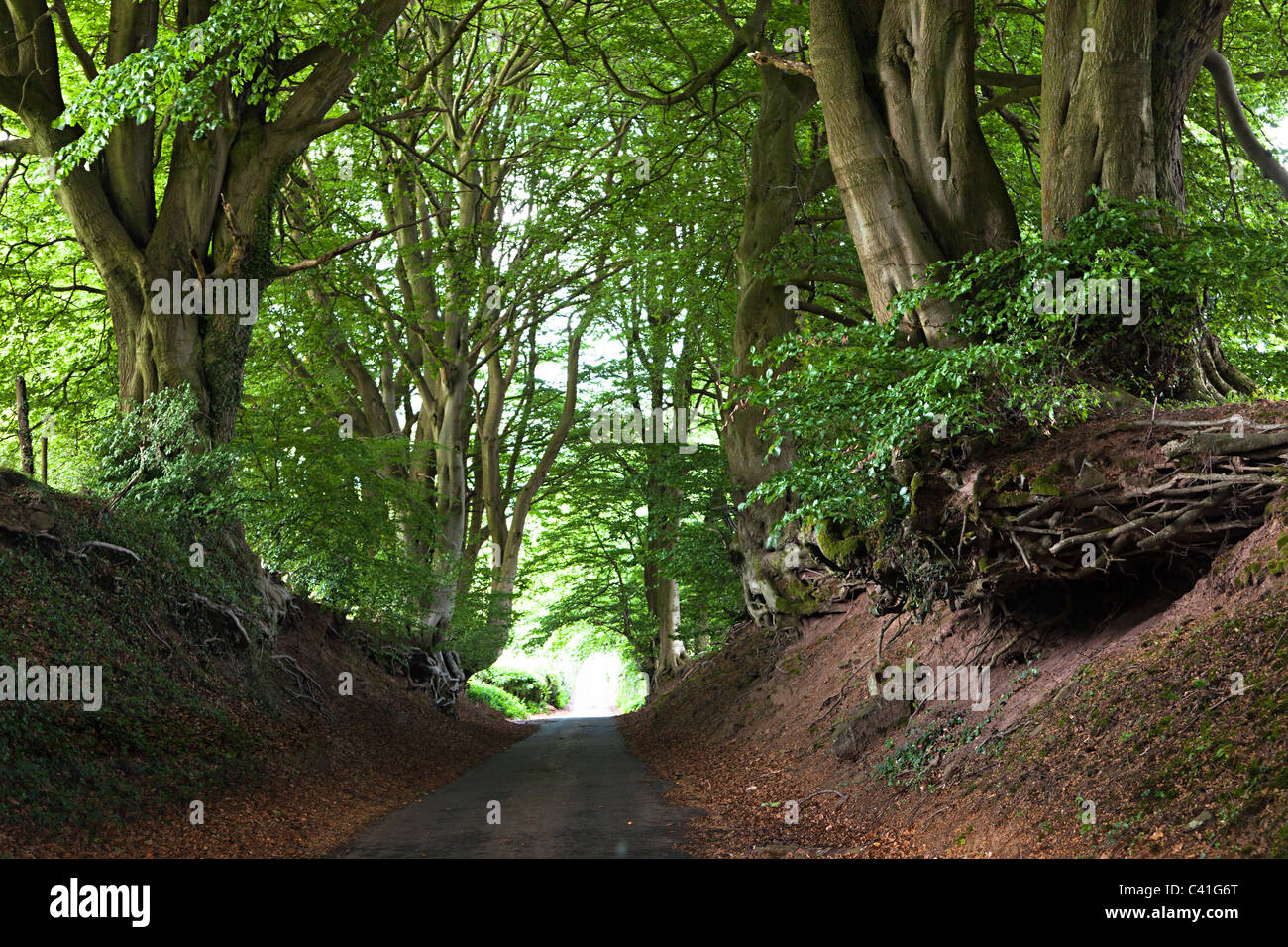
I've lived in the countryside for 14 years. I don't walk on the roads where I live. The roads are narrow and there is no place to walk as the side of the roads are raised embankments built from tree roots. Looks like this: http://c8.alamy.com/comp/C41G6T/country-lane-with-trees-form...
The roads are narrow, so you don't walk? What? That makes no sense.
Living somewhere that you can't even walk around sounds like some kind of prison. How do you get around? It sounds like you are unable to get around without burning fossil fuels. How does that make you feel?
sad to see your comment down voted but there are laws that bicyclist have to obey and they should prove they know them. this would include showing they understand the protective gear requirements and how proper attire protects them.
it isn't uncommon near some bike parks where I am for groups to block intersections which only serves to aggravate drivers. The are required in many areas to pass through intersections like all other vehicles, alternating with those waiting on the cross roads.
the bikes should be tagged to indicate they have the proper reflectors and lighting. there are still too many riding without reflective clothing let alone any type of lighting in low light conditions. I ride, I hate the idiots that ruin the sport
I imagine your suggestions would cause more deaths than they would prevent by sucking all the joy out of cycling, causing more people to just use a car instead, leading to more dangerous accidents and more obesity.
I have Zen Internet. It is a little bit more expensive than competitors such as BT and TalkTalk, but the customer service is so much better! It’s all in-house, run from their office in the U.K.
The Fritzbox! router is fast, reliable, has great WiFi and looks like a spaceship!
QC25s are great at reducing noise, but it’s not just noise that’s the issue! I find that older planes have more more vibration in cabin and that’s not something that noise cancelling headphones can help with.
I’m not sure about that. A lot of people purchase run down homes and renovate them, often selling these homes for good profit. That’s not due to the increasing value of land?
Yes you are right. What my mate often does is add value through renovation and/or extension. For example, one house was very run down and was on a large plot of land. He renovated the main house, and extended it, building an extra bedroom and detached garage. He then divided the land and built a new house on a separate plot. Then sold both houses. His net profit was around £150K I believe. Other projects are smaller, such as just a straight renovation. On his current personal house he bought it for around £350K - it was very run down. He lived in a caravan on site for 18 months while he renovated and extended. He has since extended twice, and converted the barns into living accommodation. Estimated value now is around £2million. He owns another property outright that he rents out. Rental income around £1,400 a month net. That property is worth around £500K I would say.
What are your problems with homebrew? I have my share of them, but I wonder if your problems are more community oriented, MacOS oriented, or brew itself.
I used to love Homebrew, but I recently uninstalled it from my machines and went back to MacPorts. This was motivated by the discovery that the lead maintainer of Homebrew is a huge jerk. The tl;dr is he deliberately took offense at inadvertent rudeness in someone's GitHub comment that they had already edited to remove (he recognized this and quoted the original form from the email anyway), then subsequently threatened to ban them from the Homebrew GitHub organization for politely asking that their issue be reopened, and when I pointed this out, he banned me and deleted the relevant comments.
I used Homebrew back when it wouldn’t work without chowning /usr/local/bin. I’m not sure if that is still a requirement, but it did leave a bitter after taste.
Beside that, I like to install packages from their canonical source. That could mean installing Go from golang.org to MariaDB from mariadb.org. It’s simple to compare sha256 checksums, which I suspect is also possible with Homebrew, I just don’t know how.
I think disposable income is great! I like having it as much as the next person, but gosh do I waste it! If I saved all the cash I’ve “donated” in tips and excessive spending I’m certain I’d have a couple $1000 more in the bank and would be much closer to building that track car I’ve been fantasising about.
I often read the comments before I read the link. I’m not sure when I started doing this, but I found it gives me a diverse range of opinions that I can consider when reading the content.


----
It's a shame I'm getting downvoted, but the current state of affairs is that in cities like London bicycles, cars and trucks will be sharing the road for the near-mid future.
I'd rather not have trucks or cars in the city, and ideally cyclists would have their own road separate from cars and pedestrians, but I think that's a pipe dream.
Until then what else can do we? At least if we require tests for cyclists, like we do for cars, buses and trucks, it might help reduce the number of cyclists doing risky things that perhaps they aren't even aware of?
Sure there are still reckless drivers, but at least they have a license that can be revoked and points that can be fined. How do we ban reckless cyclists from the road?