This is great, and it also feels like a great way to answer the question "Where should I buy a house if I want to be close to the center but not in the expensive area?".
> Let’s play a guessing game. How much more valuable is land in Manhattan than in the Bronx? Take a guess, then scroll down for the answer.
As someone who has never been in New York and doesn't live in the US, I knew beforehand that I would fail this test very hard, haha.
Manhattan is where basically everything you might associate with New York is (Empire State building, World Trade Center, Times Square, Central Park, etc.). The Bronx is where Jennifer Lopez reminds us that she came from as she keeps it real.
Although true, I feel it's worth adding here that the problem is that PM. While looking stupid by asking questions can "do you in" when working with incompetent managers like that, I'd argue that most managers will look at results -- and asking dumb questions can lead to much better results compared to just staying quiet and hoping for the best.
I bought a 200 dollar jacket and it had holes in it within months, just from regular use. I have an old 3 dollar shirt I bought years ago and it's only now beginning to show wear.
One problem this shows, is that as a consumer I have no idea what the hell is quality clothing. Clearly, expensive does not always mean high quality. And I'm not buying "brand" clothing either.
Another problem is the dive to the bottom that the industry has suffered.
Your experience is very common, I have a fake nike sweatshirt I bought more than a decade ago from a random street seller (emergency on a trip) which still outlasts current brand clothes.
Consumers' ignorance is not the problem, it used to be generally true that the more expensive item was better. Every brand has seemingly decided to burn their furniture to heat the house though, and what we experience is not as much consumer ignorance as it is a lack of names deserving trust.
I tried to be a good boy and wrote to the company asking for zipper parts to fix it and they told me to buy another jacket.
So I looked for companies that advertise repairability and found Patagonia made the most believable claims. Quite reasonable now that I'm old and rich, but I wouldn't have had the choice when young and poor.
I've started buying "nicer" things purely for fit reasons, like I've realized that I'm a lean 6' guy with a long torso, so for shirts and especially sweaters a medium is too short and a large is too baggy— the correct size for me in off-the-rack items is a tall medium, and that's definitely not available everywhere.
So I'm extremely happy with a Land's End quarter zip that I picked up recently, and I hope that's a well-made piece that will last a while, but overall I completely agree that mass-produced clothing is a market for lemons; no one can tell what the good stuff is, so it's all assumed to be garbage and priced accordingly.
Buy second hand clothes. These are either very, very, cheap, and they last just long enough for me to get bored with them. Or they are merely fairly cheap and last almost forever because the stuff that quickly falls apart doesn't get resold, it gets discarded by the person who bought it new.
In either case I have lengthened the time between manufacturing and landfill and had the enjoyment of clothes that I would otherwise not have been able to afford along the way.
I've tried, but I've been to so many thrift stores and never found anything I liked or which fit well. I'm a tall guy and the men's section of thrift stores is just filled with what I assume is the clothes that widows donate after their husbands die. And I don't mean that as a joke, half of it looks like something a small boxy train conductor in the 50s would wear.
I think my parents knew this. I grew up with second hand clothes almost exclusively and didn't really know until I asked my parents about it when I was older. It is a great strat to find quality clothes.
Yep :/ There are just no good heuristics left for quality clothing. It's horrible. One thing I do genuinely have good experience with is Japanese denim. But that's about it.
I've been trying to buy winter coats at end of season (coincidentally; not chasing sales), and one thing is consistent: fabric content is only hinted at. "Full wool" but "slightly stretchy" - possible with a broadcloth woven wool, but more likely "full"!=100%. "Cashmere" at prices that can (at best) be 10% cashmere, but might be 2% just to avoid outright fraud.
I bought a really good-looking dark blue fedora; I received a really good-looking black fedora a size-and-a-1/2 too big. I had to fight them at the credit card level, because they offered me half off at best for a hat I can't wear.
What is inconsistent: only some of them are fraudulent fronts. I'd guess about 25-50% right now, based on my recent shopping experiences. But not all: I ordered some expensive gloves; their advertised fit was wrong; we settled on 50% off (I /can/ wear them, but it's not ideal, and their return policy clearly required me to ship back). That firm had shite measurement guides, but honest merchant fronting.
I've ordered super-cool button-front shirts that ended up being tissue-like fabric. Grrr...
Speaking of fabric... Amazon folded Fabric.com into their Borg cube, and you CANNOT buy fabric by weight online - for some goddamn reason. I want to buy 100% white cotton for a play costume, and need it thicker - between sheeting and terrycloth; closer to the latter; Nothing else really matters to me about it. But can I determine the cloth thickness/weight? Nope.
So: 50% swindlers; 75% idiots; buy clothes in person or else expect to throw a certain amount away.
In Europe if a garment says 100% New Wool it had better be just that. I have several coats with varying proportions of wool, nylon, etc. All bought secondhand and of very high quality compared to the price I paid.
Of course they aren't the latest fashion but clothes that last are by definition out of fashion for most of their existence.
A “quality” jacket in the 1930s would cost 300-400$ or more inflation adjusted, it would also look less fashionable today, and feel somewhat less comfortable due to several concessions for durability in design. A durable quality jacket back then was also holding a majority market position, rather than being a niche good, which means that “quality clothes” do still seem to exist, but I’m always looking at 500-600$ for durable jeans or coats.
>but I’m always looking at 500-600$ for durable jeans
tf.
That’s clearly you looking for a specific fashion or intending to pay as much as you can.
Triple Aught Design jeans are $150 to $250 and I am skeptical you have anything that is outlasting them. Others brands surely as well. Seems to me you are still stuck in the “if it costs more…” line of thinking.
No, I am just buying import Japanese jeans from the folk that bought all of the original high quality jeans making machines when the Americans moved to the flexi stuff, the jeans I buy last with next to no damage for 10-15 years despite near daily wear.
I will grant you that I am paying a premium for both import, and a particular quality of fabric, but honestly I look like farmer Joe mostly.
I recently ordered some Levis that I'm happy with, but I think there's also a limit for me in that certain life-things can happen that will end a garment regardless of how much was paid for it or how much it was babied.
I'm pretty disciplined about wearing a bib in the kitchen these days, but you can still get a glass of wine on it at the dinner table, or sparks from a campfire, or a cycling wipeout. Those are annoying at the best of times, but particularly if it ends a garment that you paid 3-5x normal price for specifically so you could have it forever.
having burned though easily 10 pairs of Triple Aught pants of various designs, they are well made and attractive, but durability is not an outlier from my experience. each design consistently fails in the same area with regular use. i tend to repurchase the designs that fit and function well, but they all inevitably fall.
I understand your sentiment. I personally would never use a textbook for anything code related, if there's no proper documentation online then I wouldn't touch it with a ten-foot pole, haha.
However, even though I've never worked with CassandraDB, I feel pretty confident that I could do it with Claude Code. Not just "do it for me", but more like "I have done a lot of database migrations in my time, but haven't worked with CassandraDB in particular. Can you explain to me the complexities of this migration, and come up with a plan for doing it, given the specifics of this project?"
That question alone is already a massive improvement over a few years ago. I don't feel like I was using my "critical thinking muscles" when I tried to figure out how the hell to get hadoop to run on windows, that was just an exercise in frustration as none of the documentation matched the actual experience I was getting. Doing it together with Claude Code would be so much easier, because it'll say something like "Oh yeah this is because you still need to install XYZ, you can do that by running this line here: ...".
Now I'm not saying that Claude Code, and agentic in general, isn't taking away some of my critical thinking: it really is. But it also allows me to learn new skills much more quickly. It feels more like pair programming with someone who is a better programmer than me, but a much worse architect. The trick is to keep challenging yourself to take an active role in the process and not just tell it to "do it", I think.
Oh, I agree with what you’re saying and that’s sort of how I mostly use AI as well. The problem I have with my company is they’ve stepped from measuring success by the outcomes to measuring the means to achieve it. My opinion is - It forces people to operate a certain way potentially at their own expense, unwittingly even.
Don't we already harvest more food than humans could ever eat, and have a huge pharmaceutical industry? I get what you're saying but these two examples seem counterproductive imho.
Which begs the question: what would actually be a good field to apply human potential towards? I agree that finance, sales and ads are very low on that list.
I would imagine that increasing crop yields would do social good primarily via decreasing the amount of cultivated farm land, especially since we're well past Jevons paradox territory with calorie intake I imagine.
While the pharmaceutical industry is large, the marginal researcher does still seem to have a pretty positive impact from an outside view.
The most positive use of human time probably looks something like antiwar advocacy, but I don't really think that most quants have the social skills for that tbh.
I have good news and bad news for you. Good news: we've known the solution to that for more than a century, which is to reduce livestock consumption, a cause which many smart people have dedicated their lives pushing vegetarian/vegan culture and producing alternatives. Bad news: from my point of view, the masses are not going to give up meat and eggs faster with each additional alternative meat.
As a side note, for many vegetarians and vegans, “alternative meats” actually mean hundreds of different legumes (fresh, dried, milled, split, fermented…) and other delicious plant foods. They’re packed with macro and micronutrients that can replace[0] those found in meat.
Taste is a bit trickier: nothing will ever taste more like flesh than… flesh — and taste is subjective anyway. Meat substitutes can be tasty, but they’re not the same. Which brings me to this:
the masses are not going to give up meat and eggs
That’s true. At first, giving up meat just to eat “fake meat” can feel like a downgrade. But the real key to change is curiosity. There are so many ingredients and recipes to explore. Classic egg-and-milk pancakes are great — but why eat the same thing all the time when there are so many combinations of plant milks and oils to try? I used to love pig and chicken. Now my favorite staples are fried tempeh and lentils with nutritional yeast.
0: I like to joke that meat replace beans, you get the idea. Fun fact: meat is viande in French, from latin vivenda which mean "which sustains life" and used to describe any edible. I think english meat have a similar etymology from mete.
It isn’t all or nothing. The Cuban Missile Crisis should have led to war, but we stopped it. World War I never should have happened. The right answer is to acknowledge envy, greed, and laziness but find solutions to work around these problems.
>While the pharmaceutical industry is large, the marginal researcher does still seem to have a pretty positive impact from an outside view.
From this outsider's point of view it's failed to have a positive impact; people nowadays are far less healthy and happy than they were half a century ago when the pharmaceutical industry barely existed.
Life expectancy in developed nations is years higher today than 50 years ago. Pharma has contributed to that with things like new vaccines, antibiotics, antivirals, and statins.
I think energy is actually the most underserved sector, with maybe high tech manufacturing as a hidden second.
Just look at what happened when AI took off in the US and our ongoing struggle to get global warming under control - only China is taking a serious stab at this which is why they’re absorbing AI more effectively than we are.
Also semiconductor manufacturing has clearly gotten way too concentrated and there’s not enough experimentation with new designs (eg throwing more at existing DRAM designs instead of building new designs like in-RAM compute to shift the power and performance by an order of magnitude or 2 thereby easing the pressure of how much is built).
It’s been a few years since I looked deeply into it, but I think we produce enough to have everyone survive but not necessarily thrive. At the time, it came out to something like 1700 kcal per person. Even if we did have enough, the next problem is logistics of allocating that food to everyone who needs it.
A lot of food production worldwide is used by meat production, which is quite inefficient. It does generate some useful side product (manure), but also a lot of bad side product.
In some places, almost every field is dedicated to meat production.
Consuming less meat and shifting food production away from meat would be very good for the environment and instantly solve the issue of the amount of calorie produce.
But as you pointed out, this is not the actual issue. Getting food to people who need it is almost entirely a political and logistical issue at this point. War (especially civil war), natural disaster, with local power stealing international aid, etc, are mostly the biggest responsible for hunger in the 21' century.
We have the technology and logistics to accurately drop-ship huge amount of food in even the most remote places in the world, even when the local infrastructure is heavily damaged or inexistent. We cannot deal with local power decision to voluntarily starve a place.
>Consuming less meat and shifting food production away from meat would be very good for the environment and instantly solve the issue of the amount of calorie produce.
The problem with this statement is that it implies all calories are equal in terms of nutrition. Meat is very protein dense compared to most plant foods and that can be important. That’s not to say it’s impossible to live healthily on only plants, but it’s not as simple as swapping calorie sources.
Fun fact, some plant like Bulgur or Lentil are almost as calorie dense as some meat. But to my understanding, they lack “complex” protein or something ? Regardless, your don't have to cut meat entirely. The issue is that we consuming way too much of it. In many developed country, eating meat every day is very common. Eating meat once or twice a week is enough to get all the right nutrient and not having deficiency in things like B12.
They lack all the essential amino acids, but you can easily circumvent that by combining sources. People have been doing so with combinations like rice and beans for generations. But the question is whether the calories cited come from enough variety to meet those nutritional needs. Again, all calories aren’t created equal.
I don’t disagree that western societies probably eat too much meat. But that is the trend of any burgeoning middle class, and it’s doubtful it will change.
The average per capita is closer to 2,600 kcal/day. Not sure how that breaks down when normalized by the individual country population. It also doesn't include waste. In the US at least, waste is near 40%.
At the top, under FOOD, select "All food." In the country list, select "World." Above the map, click "Line." Finally, mouse over the graph to see the values. The latest value they have is for 2023 and shows 3,005.52kcal/day. Awful lot of significant figures there....
I feel like this is very much a personal preference thing.
They even called out Horizon Zero Dawn for looking very bad, and Zelda for looking very good.. while in my opinion the exact opposite is true.
I do see the point of the author: HZD goes for a "realistic", high-fidelity 3D fantasy world, yet the lighting makes no sense in physical terms. The contrast and brightness shown in the picture are all over the place, and can only be an artifact of visualising a world through a computer screen which has a very limited dynamic range - it is immersion-breaking. The Resident Evil 7 picture below looks much better. The video I linked in another comment explains why: in the physical world, the stronger the light, the more washed-out the colour will become. HZD is a saturated, high-contrast mess with too much compression in the low light, because of a bad colour mapper in their pipeline.
One can claim HZD's look is an "artistic choice" and that's inarguable, but the author believes it's simply not enough attention to the tone mapping process, which is a very complicated topic that's not usually taken seriously in game dev compared to film production.
To be fair - if I remember the location correctly - that screenshot is somewhat misleading because it's camera position is from the inside of a large ruin, with the ceiling and right wall of the "cave entrance" being just outside the frame.
No, the author posits that Zelda explicitly goes for artistry and ignores any pretense of realism (that then falls flat on it's face when using an over-contrasting tone-map like in the HZD screenshot).
The problem I personally have with the Zelda example given is that it looks really bland to me - the landscape looks really washed out - the author says "Somebody would paint this. It’s artistic.", but I don't think anyone would paint with such bleached-out colours.
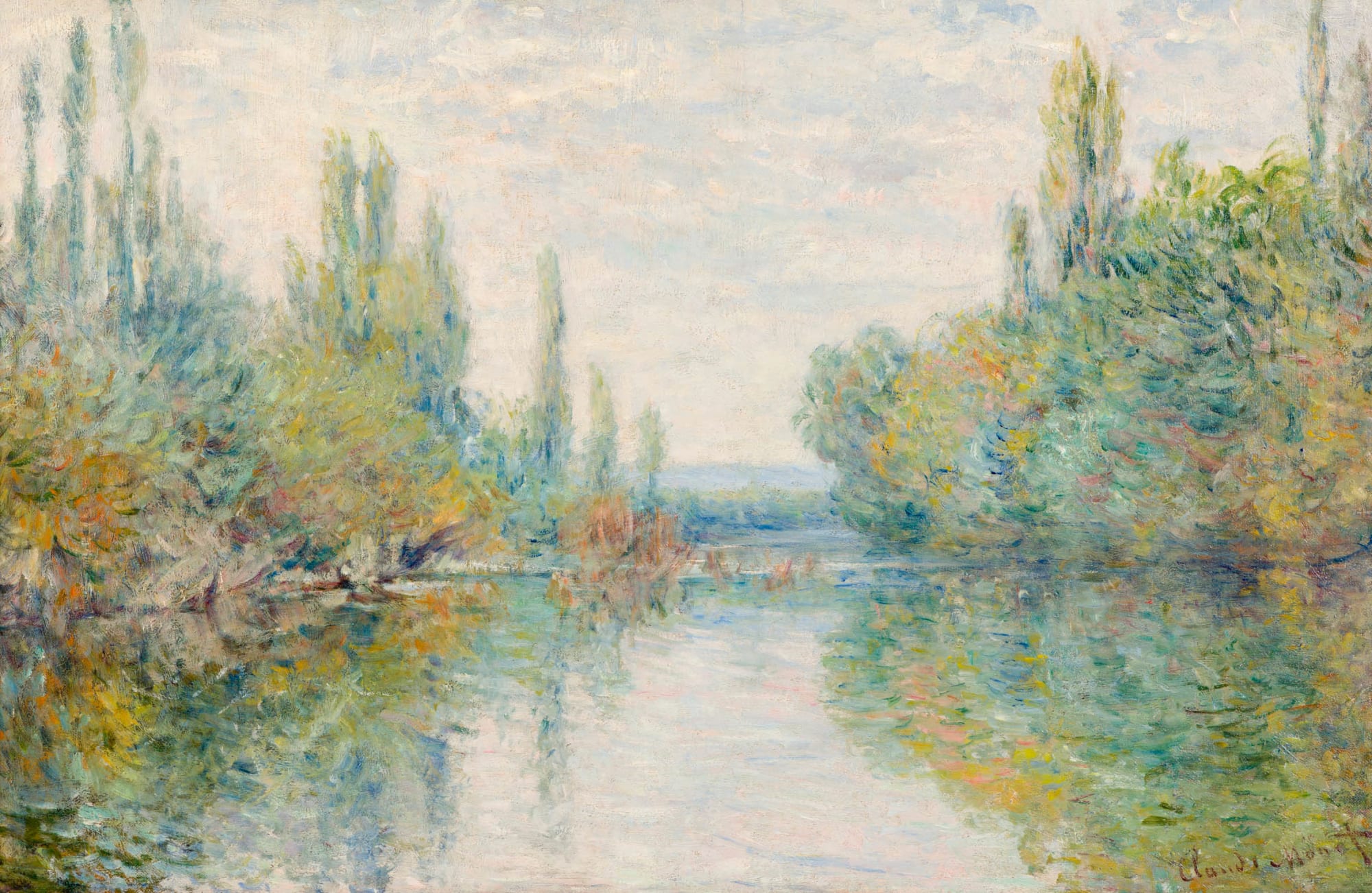
In the painting there's a delicate interrelation between colours - you have browns/greens/blues in the dark parts, and more whites/yellows/blues/pinks in the light parts. I wouldn't describe it as bland, though it is in a sense washed-out. BotW doesn't, and probably can't have that level of handling of shades colour in the enviroment graphics if nothign else because of the technical constraints of the Switch hardware.
Looking at the screenshot, what can you say - you can say that it's nice that the green/yellow of the sky is mirrored in the green landcape with yellow rivers. And the back-lighting of the sun is helping give definition to some of the mountains/hills, which is nice. But I don't see very much subtle going on with the landscape.
Looking at the art, you can see a lot more dynamic range, clearer silhouetting of mountain ranges at various distances, whereas the actual game is more monotone-green. You can also see the fog doing a lot more work of making the shape of the land clear. There are some bits of fog/mist in the screenshot as well, but they're not doing as much heavy lifting in terms of giving shape to the landscape.
The Switch is really limited on the hardware front, and I can't imagine what kind of trade-offs the art team had to make to get to where they are - it's a very difficult balancing act that I only understand a small part of. Nintendo also tend to be very conservative/restrained in their 3d style (I remember being somewhat unnerved by Ubisoft's "Mario + Rabbids Kingdom Battle" Mario game, because it went super high-production-quality).
It feels a bit cheap to give as an example, but the 3D MMO Love by eskil steenberg tried to emulate the impressionist style, and did a striking job:
https://imgur.com/9U18eRZ
The bloom effect is doing a lot of heavy lifting to make the bright colours pop, but even in the less glowy areas there is quite subtle layering of colours going on and one does have the feeling that the colours are playing with eachother.
( https://www.youtube.com/watch?v=Cc02ijaw-Tg a video of it in action, if you are curious ).
As another comparison, looking at elden ring you can see they've gotten 'using fog to make landscape silhouettes pop' down to a fine-art (maybe they're even over-reliant on it)
https://imgur.com/a/5GEePwL
And looking at the landscape you have really nice looking brown/oranges in the fields in the foreground, black/greys/browns in the mid-ground, rocky cliffs, fog is actually glowing, and you have some green forests in the top-left. That's a lot of nuance for what's essentially a brown landscape. BoTW doesn't have that - would it have it if the team had the hardware capabilities and time and budget? Who knows...
Oh, I see. I disagree that the original HZD had a pretense of realism though. The remastered version does and well illustrates the uncanny-ness https://www.youtube.com/watch?v=IlWK_ELBW08 . The outrageous god rays, bloom and lens flare in the remaster compensate for that because you can't actually see anything due to them blinding you...
I think with enough exposure to the overdone contrast ratios, you start to get tired of it. It sacrifices a lot of clarity.
I agree it does look good in some cases, for example I enjoy the look of Battlefield 1 a lot, but when playing it I often noticed I had issues seeing detail in darker areas.
The question is: is AI breaking the system, or was it always broken and does AI merely show what is broken about it?
I'm not a scientist/researcher myself, but from what I hear from friends who are, the whole "industry" (which is really what it is) is riddled with corruption, politics, broken systems and lack of actual scientific interest.
It really depends on the use-case. I currently work in the video streaming industry, and my team has been building production-quality code for 2 years now. Here are some things that are going really well:
* Determine what is happening in a scene/video
* Translating subtitles to very specific local slang
* Summarizing scripts
* Estimating how well a new show will do with a given audience
* Filling gaps in the metadata provided by publishers, such as genres, topics, themes
* Finding the most "viral" or "interesting" moments in a video (combo of LLM and "traditional" ML)
There's much more, but I think the general trend here is not "chatbots" or "fixing code", it's automating stuff that we used armies of people to do. And as we progress, we find that we can do better than humans at a fraction of the cost.
I know this is just a casual comment, but this is a genuine concern I have every day. However, I've been working for 10 years now and working in music/video streaming has been the most "societal value" I've had thus far.
I've worked at Apple, in finance, in consumer goods.. everywhere is just terrible. Music/Video streaming has been the closest thing I could find to actually being valuable, or at least not making the world worse.
I'd love to work at an NGO or something, but I'm honestly not that eager to lose 70% of my salary to do so. And I can't work in pure research because I don't have a PhD.
What industry do you work in, if you don't mind me asking?
It's not a casual comment in the sense that I have genuine concern every day that the current world we are living in is enabled by common employees. I'm not saying everyone should solve world hunger, "NGO or bust" - and yes, the job market is tough - but especially for software engineers, there are literally hundreds of thousands of companies requiring software work and who do net good or at least "plausible" harm, and pay an above average salary.
Also I only read the comment above, it's you who can judge what you contribute to and what you find fair. I just wish there were a mandatory "code of conduct" for engineers. The way AI is reshaping the field, I could imagine this becoming more like a medical/law field where this would be possible.
I work in IoT telemetrics. The company is rumored to partake in military contracts at a future point, that would be my exit then.
I work in R&D, and although I haven't signed an NDA, I think it's best if I don't elaborate too much. But basically we have a large dataset of shows and movies for which we already know how well they did with specific audiences, but we didn't know why exactly. So we use LLMs to reverse-engineer a large amount of metadata about these shows, and then use traditional ML to train a model that learns which feature appeal to which audiences.
Most stuff is obvious: nobody needs to tell you what segment of society is drawn to soap operas or action movies, for example. But there's plenty of room for nuance in some areas.
This doesn't guarantee that it actually becomes a succesful movie or show, though. That's a different project and frankly, a lot harder. Things like which actors, which writers, which directors, which studio are involved, and how much budget the show has.. it feels more like Moneyball but with more intangible variables.
For me it depends on open tabs: with modern firefox 4 digit number of open tabs on a 64GB machine is no problem. Chromium crawls to a halt at low 3 digits.
I've been satisfied with Firefox speed for several years, ever since Chrome manifest version 3 crap started to become reality.
I keep many browsers on my laptop and use whichever one I must for in-compatibility reasons and primarily Firefox which makes me generally a happy camper. Mac os.


> Let’s play a guessing game. How much more valuable is land in Manhattan than in the Bronx? Take a guess, then scroll down for the answer.
As someone who has never been in New York and doesn't live in the US, I knew beforehand that I would fail this test very hard, haha.
reply