I like how you aren't hiding the fact this is MJML under the hood and don't layer complex abstractions over MJML spec like similar projects (cough react email cough).
The devs maintaining MJML deserve so much credit for dealing with Gmail/Outlook's monopoly bullshit and 2007 html.
Nice idea for those who manage content in markdown. I've moved away from putting emails in my codebase, but seems great for founders moving fast.
You've accurately described what could happen with right-wing authoritarians in power. You've not described what could happen with left-wing authoritarians in power.
Don't be fooled that your team doesn't have people with the same impulses. Privacy and civil liberties exist to protect us from abuse of authority on all sides.
- "Oh I see John is connected to this account. I really don't like this HN comment and opinion he posted, I find it deeply offensive. Put him on the bank KYC fail list."
- "We'd love to give you this mortgage backed by the US government, but why didn't you post the right flag in support of the new hip thing?"
- "Before you login to your retirement account, how much wealth are you secretly harboring there from this job we think you unfairly got due to your privilege?"
- "If you just let us monitor your activity and the ideas you see, we'll stop you from wrong-think and will create a utopia"
That would be a solution if the people pushing this actually cared about "protecting kids."
But let's be honest, governments want a dragnet they can use to monitor/control all internet communication. The people running western democracies are equally as power hungry and zealously authoritarian (my ideas will bring utopia!) as the people running the CCP.
The only difference is, the CCP has permissionless authority, so they ended internet freedom in China decades ago. They didn't have to ask.
Western authoritarians on the other hand, have to fight a slow battle to cleverly grind you down over time, so that you get tricked into allowing them to gatekeep the internet. It hasn't worked so far. The next step (this one) is "okay, so you don't want to have to ask us permission before you visit a website...but won't anybody think of the poor beautiful innocent children???"
Emotions activated. Rational thought deactivated.
They'll get what they want because they always get what they want. And you'll be convinced it's good for you over time, because most people just follow whatever the mainstream "vibes" are, and the elite sets the vibes. It's amazing a free internet existed this long. Great while it lasted.
i'm only half joking. adding zkps to http requests is probably the correct privacy preserving technical solution that could be built into something sensible.
the bigger issue is that lawmakers are thinking in terms of smartphones, tablets and commercial pcs as shrink wrapped media consumption devices with a setup step... not protocol level support that preserves parts of computing and the internet they don't even really know exists. seems like the ietf should have lobbyists or something.
ZKPs don't buy anything, since an online service can sell them by the thousand and you're just trusting the client that it belongs to the actual user. You might as well just do "User-Age-Category: 18plus" then and save a headache.
Yeah, so some guy is selling his zkps by the millions for a dollar each. Since they're zkps you can't find out who it was, and the system is pointless.
no. you can pay verisign or google or the government of estonia or whatever for a digital id and they can issue you a zkp that is signed by them that attests whatever without giving up your identity.
> The print editions of the very same publications — The New York Times, The Guardian, The Wall Street Journal, The Atlantic, The New Yorker — don’t do anything like this.
Yes because they don't give the print editions away for free.
You go to these sites as a free user, you get exactly what you paid for.
The only reason you're confronted with articles from these legacy publications in the first place is because they've lobbied governments to get google to force them into their carousels and recommendations.
You go to these sites as a free user, you get exactly what you paid for.
Yeah? How about when I go to the site as a paid subscriber and get the exact same experience? Did the number or obnoxiousness of ads go down when I gave NYT money? Nope.
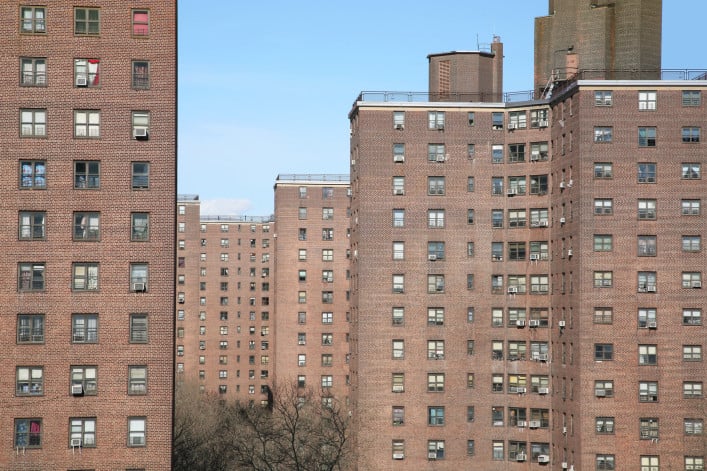
Because "cheap" government housing has never been "high quality" in the history of the world. Those two properties are antithetical.
Humans don't have a ton of preferences for the electricity they consume or the water they drink, just that it exists. It's a commodity, so a good task for government. Housing is not an undifferentiated commodity and is subject to extreme variances in preference. Markets do differentiation and preference matching infinitely better.
Hence why Government housing always takes the form of a utilitarian blight on the community with giant towers of tiny apartments with tiny windows...doesn't matter if its communist Russia or the richest capitalist city on earth (NYC), all government housing results in the same outcome.
Assuming someone will chime in with some "halo" government housing project in the nordics that represents like 0.01% of the government stock there but socialists will use as propaganda. However, it's important to remember these are not cherry picked examples, they are median examples:
France has similar issues as the US housing projects from the 70s (creating ghettos), these are not places that people choose to live. And yes, all governments put up halo projects that you see in the press that do not represent the average, please link me to them claiming I'm wrong, and I will say yes, this halo project designed by a famous architecture firm does look nice! Now show me the median late-1970s constructed French public apartment.
Singapore is different because they eliminated the "cheap" part. Singaporean HDB flats are expensive, have extremely long wait times (you're stuck for life when one comes up), while still being super tiny. Fertility rates are 0.87 there (replacement rate is 2.1). The domestic population is literally disappearing itself. I'm sure highly regulated tiny housing stock and development policy has no influence on family size though...
The floor space and the proximity to neighbors are perfectly valid reasons to not prefer apartments. Calling them a "blight" is bs, unless you had in mind as your ideal something like historic parts of London because rows of identical mansions in a suburb looks to me no different than rows of vertically stacked apartment blocks. They are both clean, geometric and "industrial" looks.
Not just government made housing but any housing. Housing market needs don't seem to have as much wide fragmentation as eg most of the Western world seems quite happy with suburb style housing and most asia seems content with apartment though aspiring to owning houses.
I am saying just like any other capitalist endeavour, where things that barely existed or were quite expensive many years ago eventually reached a point where both the price became so low and quality so good that it became a mindlesss thing eg sawblades. And housing for whatever reason has been an extremely anticapitalist market. Even if we take the exact same houses people want today, their execution seems far from optimized. Think of something like precutting all the timber and sheets at a factory and doing some light adjustment and fitting on site, developing new materials that are cheaper or easier to work with tools, etc there are countless angles of attack.
In optics for example, it was mostly this rather bespoke work by a few artisans and people back then might have said this needs a fine touch that can't be done on mass scale. And then Carl Zeiss emerged. I feel housing is in the pre Carl Zeiss era.
EDIT: Neither example looks bad to me. The russian looks denser but both look clean and well organized. It doesn't at all look like blight to me, any more than a grid of houses in a suburb does. It's clean and geometric just like rows of houses in suburbs. If you like one but have a problem with another, I think you are trying to get offended deliberately.
Construction costs don't scale linearly with rent prices, it's a different market altogether that depends on regulation/worker supply/material costs/equipment/etc.
As long as construction costs remain below the value of the units all-in, there's profit motive for developers to build.
> As long as construction costs remain below the value of the units all-in, there's profit motive for developers to build.
Not true
Real estate development is extremely capital intensive and therefore it's a question of all-in cost of capital compared to other investment opportunities.
The opportunity cost has already factored that in. Unless you think cost calculations are arbitrarily forgetting to include certain costs for no reason?
Well for sure in the actual financial models yes, but it's demonstrably true that most HN commenters here do not know this is how to think about the question of returns.
And FWIW "opportunity cost" doesn't really show up as "a cost" in the traditional sense.
> And FWIW "opportunity cost" doesn't really show up as "a cost" in the traditional sense.
I cannot think of any forward-looking situation where opportunity cost doesn't show up. What case are you thinking of? The discussion, of course, is about a forward-looking situation.
In hindsight often one becomes more interested in seeing if the opportunity cost was paid. A common way to calculate that is to forget about cost and only look at expenses. More specifically, income minus expenses. The result of that calculation gives the opportunity realized. This may be what you are thinking of, but the opportunity cost is still there, it's just that the way of looking at it has changed.
Your scenario is simply describing a massive under-supply problem, and mis-attributing causality for price increases.
If the older buildings are able to raise prices 20% with no increase in vacancies after the new build, the new build not coming in would mean those older buildings rent would be bid up more than 20%.
The people moving in who could have afforded the 30% more expensive luxury units will just have to pick from the older units and outbid lower income people for spots in this low supply, growing city (under no other scenario could you crank up rent on aging stock 20% without losing to competing landlords).
Ah yes, that 150 year old meme reflexively copy-pasta'd by internet commenters since the days of usenet to refute basic concepts like supply and demand.
"Lol economists are dumb they think humans are robots!"
No they don't. Sorry, we won't be throwing away an entire field of human endeavor based on a straw man caricature that isn't true.
We don't call physicists dumb and throw out their ideas because the real world isn't a perfect vacuum either. They know this, don't be silly.
The movement of satellites is not modeled using distance = speed * time. It would do well to consider if econ 101 is an accurate way to model the world since for other domains the 101 course is not.
Yet the overwhelming factor in modeling the movement of those satellites is still distance = speed * time.
The existence of nuance and external factors don't negate the original principle.
The equivalent to arguments made by 'economics deniers' in this thread would be if you argued: the satellite moving at 7.8 km/s actually causes the earth to spin 8 km/s faster, so trying to make the satellite move faster makes it go slower! Applying acceleration doesn't help!
No. Making the satellite move faster generally makes it move faster. Building more housing generally makes it cheaper.
Let's not do the HN thing and get lost in pedantry.
> The existence of nuance and external factors don't negate the original principle.
Eh, ok throwing out all of physics 101 is a little strong. But you still don't use the original formulas you learned to do actual analysis. So using the basic models from econ 101 to do analysis can lead you to incorrect answers (but also correct ones; from a False premise you can imply both True and False; see "Material Implication" [1]).
So sure on a forum like HN it can be appropriate to use basic econ 101 logic but when somebody is trying to be an expert or write an article for thousands+ people you should really question why they're only using 101 logic.
> Let's not do the HN thing and get lost in pedantry.
Lets actually do the not HN thing and read the article.
There's too little rigor in the article to support the argument in the title. The articles _own numbers_ are that after building 120k housing units the rent went up 85% (4% decrease after 96% increase). Just looking causally at this the only data in the article supports more housing = more rent; the article is only casual observations so little reason to do anything else ...
Apparently you aren't aware of the EU's deep regulatory protectionism and subsidies at both EU and country level. A small portion is legitimately about protecting consumers, but ultimately this stuff is all designed by and for EU industry.
Basically all economic regions get highly protectionist when it comes to key areas like agriculture, banking, steel production, energy, automotive manufacturing, etc.
On tariffs, the US is now higher, but tariffs are a tax that passes through overwhelmingly onto the consumer (by like 95%+). Given there's essentially no fully domestic US manufacturing supply chains and the US imports everything, it's a defacto VAT from the perspective of the consumer. The EU has VAT levels that are still much higher than the average US tariff level, which is a essentially a dampener on consumption.



Human language is an unnecessary abstraction, just like images.
I wish everyone would communicate in pure Binary.
reply