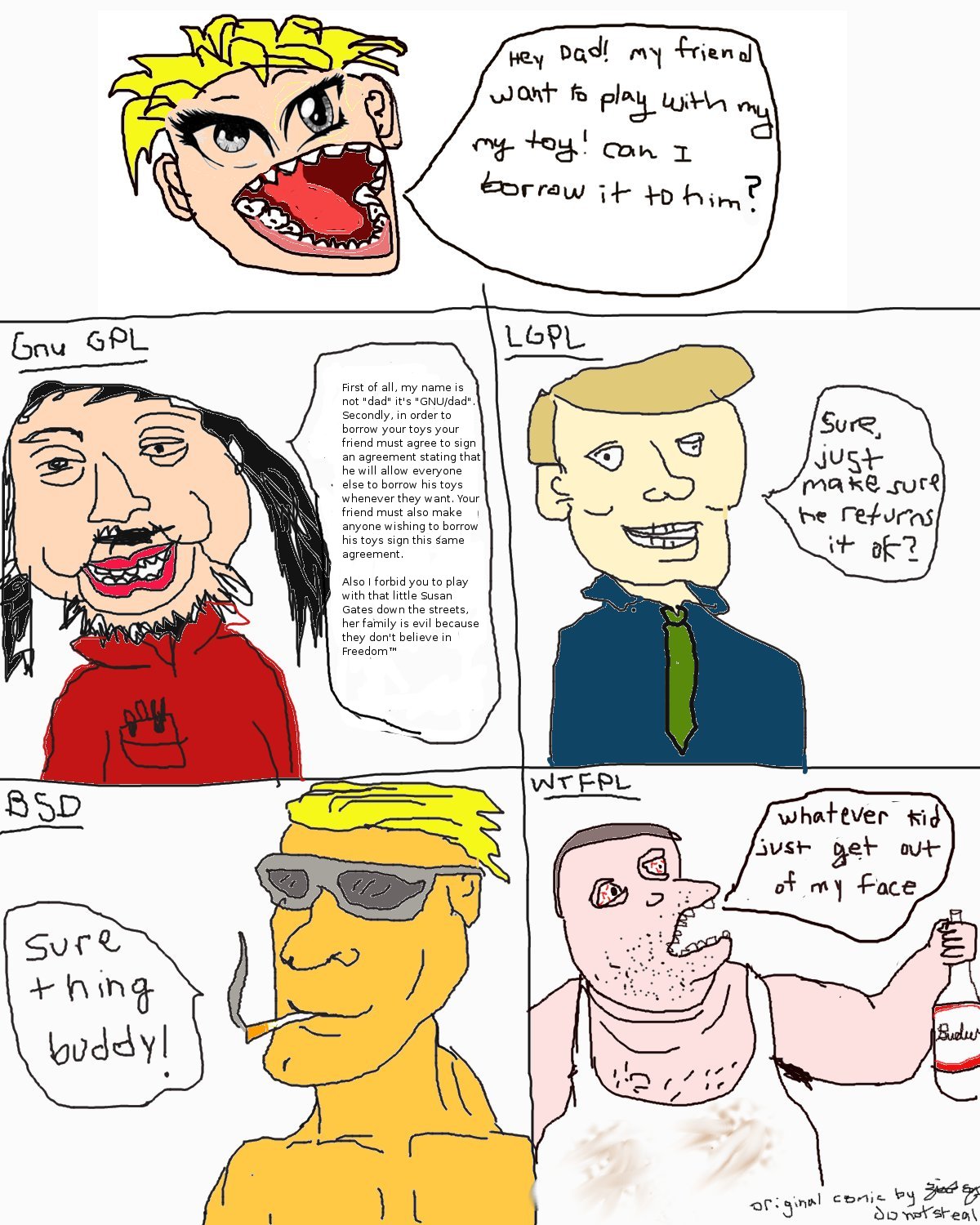
I have heard that some corporations stay away from WTFPL due to some legal uncertainties that I can't claim to understand. If you use WTFPL consider dual licensing for maximum availability.
Unless you are a lawyer or have heard it from a lawyer, you should not claim (unqualified) what a license does or does not cover.
The last clause, I think, sounds like it is meant to cover the work in question (the code). I am not asserting this is true, but lawyers have accepted this as being true. For example, the free software foundation (which has lawyers more skilled in copyright law than most places) accepts this as a free license.
I heard it from a couple lawyers (both ours and theirs) when our company was acquired and we had to do a license audit of all of our open source dependencies. It was enough of a problem that we had to remove a couple (fortunately small) WTFPL projects.
Well crap I see exactly what you mean and you're right. I'll update it (even though I don't think anyone is actually using the code from that repo). Perhaps I'll even take some time to make that repo more relevant (at least for me; it's basically a project template for me to use).
Where in the document does it actually grant you copyright license to the source code or other IP in question? The only language that's close to a grant of license is:
"Everyone is permitted to copy and distribute verbatim or modified copies of this license document, and changing it is allowed as long as the name is changed."
Notice nowhere in the WTFPL is the source code, documentation or any other IP other than the license itself actually mentioned. Compare this to the grant in the MIT license:
"Permission is hereby granted, free of charge, to any person obtaining a copy of this software and associated documentation files (the "Software"), to deal in the Software without restriction, including without limitation the rights to use, copy, modify, merge, publish, distribute, sublicense, and/or sell copies of the Software, and to permit persons to whom the Software is furnished to do so, subject to the following conditions:"
Of course you could argue "well, everyone knows that it's MEANT to grant license to the source code if you put it in a LICENSE file" but in my experience, lawyers encountering the WTFPL have pretty strongly disagreed with that stance.
"TERMS AND CONDITIONS FOR COPYING, DISTRIBUTION AND MODIFICATION" pretty clearly applies to the package accompanied by the license. I looked at the Wikipedia page and this wasn't raised as one of the objections. Do you have a link to some lawyer complaining about that? If the OSI lawyers said it's equivalent to a public domain dedication, that seems useful in countries that don't have a public domain.
One of the objections from the wikipedia article you mention: "Software licenses need to give a clear grant of rights to users to be effective, including the right to redistribute and create derivative works. "Do what the fuck you want to" is not a clear license of any recognized copyright rights; the effect is arguably no license at all."
And again, given the paragraph immediately preceding "TERMS AND CONDITIONS.." one could reasonably argue that the terms apply to the license itself since nothing else is mentioned.
This is essentially the argument I encountered when our company was acquired and we had to do a license audit of all of our dependencies and ended up having to change our codebase to remove a couple (fortunately small) WTFPL projects.
The license is the best thing about this, hands down. It's even more offensive to GPL evangelists than public domain and closed source licenses put together. Hooray Anarchy!
> And no, I don't know what planet you live in, but it's not offensive to GPL evangelists (especially not more than proprietary licenses).
I was being facetious; it was a good-natured stab at Gnu folks, not meant to be offensive and certainly not serious. I know having a sense of humor is forbidden on HN but I can afford a few points for a silly joke every now and then. I still find the WTFPL itself hilarious in a good way. :-)
The tone of your comment was that you were excited that it was offensive to a group of people. I made no change in the intent of your words. "Best thing! Even more offensive! Hooray!"
As 'good-natured stabs' go, it's pretty low-quality.
Sigh. There's always one guy in the room who has to have the joke explained to him, draining it of what little humor it may have contained.
"Hooray Anarchy!" was in direct reference to the text of the license itself, specifically "0. You just DO WHAT THE FUCK YOU WANT TO.", which is quite anarchic, if you didn't notice.
> I made no change in the intent of your words.
I'll grant that perhaps you truly did not catch my meaning (as explained above); regardless you did indeed paraphrase me not once but twice, to satisfy your need to call me out. Your perception of a hateful slur on my part is just that, perceived and not actual.
> As 'good-natured stabs' go, it's pretty low-quality.
Indeed, I never said it was a good joke. :-)
And now the poor horse is nothing but a bloody pile of meat. Satisfied?
I got where you were coming from. I just think it's crap when someone is gleeful about being offensive, then doesn't own that. I don't really care about sharp elbows in words, as long as people own them.
> Your perception of a hateful slur on my part
Speaking of 'creating false arguments', where did I say (or imply) 'hateful slur'? Why do you get to paraphrase me and at the same time object to being paraphrased?
My point is that you take joy in something being offensive, then don't own that. It wasn't meant to devolve into all this, but you seem to not be getting my point just as you think I haven't gotten yours.
> And now the poor horse is nothing but a bloody pile of meat. Satisfied?
So, I'm not sure the optional warranty disclaimer variant is actually sufficient under US law.
Disclaimers of implied warranties, e.g. warranty of merchantability and fitness for a particular purpose, need to be explicitly, and "conspicuously" disclaimed.
Apparently the legal profession has decided that means in ALL CAPS.
You appear to be operating under the assumption that the license is novel -- it is not. This is a well established license, though unfortunately not as accepted by lawyers as most open source licenses so it ends up doing more harm than good.
The license is obviously a bit tongue in cheek, but it's no different than a public domain license to GPL evangelists, other than being less legally rigorous.
I don't get your comment at all. For the life of me I can't understand why you use the word offensive or why you seem to delight in this license so much.
I prefer BSD or MIT any day, I can't take the license seriously, heck even the Beerware License sounds like a better alternative, and a quite shorter one at that. As long as the whole liability claim is shoved in somewhere all should be well.