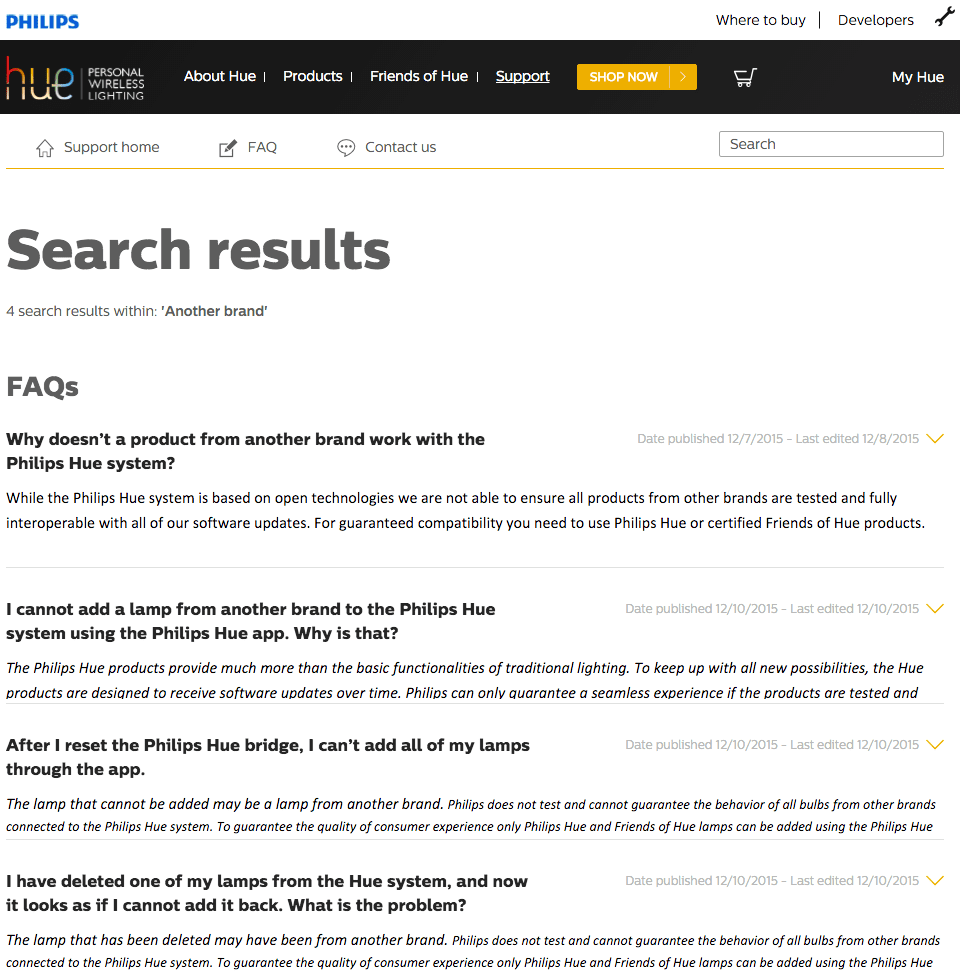
Official Reason: "The lamp that cannot be added may be a lamp from another brand. Philips does not test and cannot guarantee the behavior of all bulbs from other brands connected to the Philips Hue system. To guarantee the quality of consumer experience only Philips Hue and Friends of Hue lamps can be added using the the Philips Hue [Hub]." [1]
Real Reason: We invested money into our hub and building out our partnerships w/ Zigbee and "Friends of Hue" partners. We need to make up that money on hardware ($60 per bulb [2]) that 3rd parties could manufacture and sell for a fraction of the price. Why would we let 3rd party hardware companies leech off our investment?
Do you have evidence of the "Real Reason" scenario as opposed to the Occam's Razor scenario that (a) Philips really can't guarantee the protocol works with any lights they don't explicitly test against and (b) the reason some manufacturers can slide in at a fraction of the price is that they're cutting necessary corners in either hardware or protocol compliance? ;)
I think most users would see open connectivity protocols as a feature, and being unable to connect whatever lighting fixture they wanted to the Hue hub as a deterioration of their "consumer experience".
Connect some dodgy 3rd party lamp that is non-compliant, or worse, infects your system w/ malware and breaks your products? That's a bad consumer experience you've brought upon yourself, knowing full-well the risks. If anything, it'll make you an ever more loyal Philips Hue customer once you shell out another $200 for another starter pack and never touch the untested 3rd party stuff again.
I'd be very surprised if this was anything other than the classic case of - build a very nice garden, then wall it off, or else go broke.
I'd refrain from making assumptions until more is known.
Another hypothetical possibility is that there is some corner case of the open standard that nobody realized was ambiguous until Philips changed an implementation detail that broke (non-compliant) third-party devices, and they're now stuck in the rock / hard-place situation of deciding whether to roll back their change and remove whatever functionality or fix just got added or to apply pressure to third parties to be more compliant with the standard.
(That's the charitable interpretation that assumes their software quality process is solid enough that they can even know such nuances and subtleties as "What change did we make that broke third-party devices that aren't physically in our testing bullpen?")
Thanks for the charitable interpretation. It certainly is possible, IIRC the first Hue bridge was on the cutting edge of ZigBee and it is possible to imagine that it didn't quite get the standard exactly correct.
Whatever the reason, this is an interesting hiccup in the Internet of Things.