Hacker Newsnew | past | comments | ask | show | jobs | submitlogin
A Game of Life on Penrose Tilings (arxiv.org)
138 points by sohkamyung on Aug 31, 2017 | hide | past | favorite | 34 comments


Here's a video of the Game of Life on a Penrose Tiling:

https://www.youtube.com/watch?v=3DFi4FgzEeQ


I love that oscillator down in the bottom right!


Once I seriously wanted to have Penrose Tiling tiles in my bathroom but after soon found out nobody manufactures such tiles and would have to produce them manually with a tile cutter.


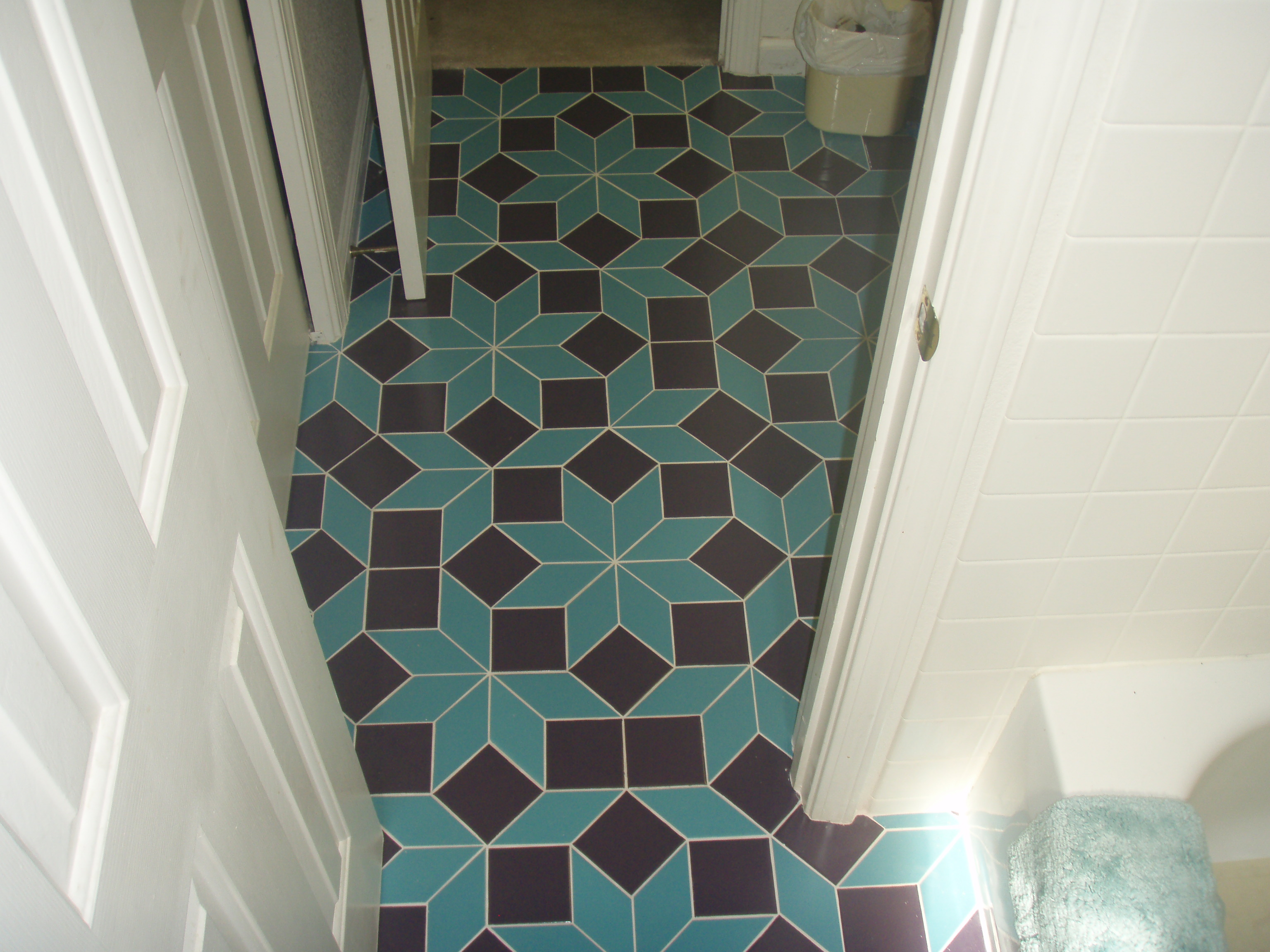
Not Penrose tilings, but my math professor's bathroom floors are pretty cool https://www.math.ucdavis.edu/~greg/floors.html


Don Knuth has a dragon curve in the entrance hall to his house: https://www.youtube.com/watch?v=v678Em6qyzk


oh holy hell it is going to be hot in Davis tomorrow.


Would probably be easier to rent or buy a kiln and then make your own ceramic tiles. Cutting them after the fact is a frustrating experience.


You'd want a slab roller too so as to get consistent thickness, unless you want a hand-made look.


The CS building in Carleton College has them in the lobby:

http://www.tilexdesign.com/portfolio/detail.cfm/C/328/Carlet...


The Oxford Mathematical Institute has one just outside the entrance. We also have Penrose himself though :P

More info:

https://www.maths.ox.ac.uk/about-us/life-oxford-mathematics/... http://www.maths.ox.ac.uk/node/865


You could buy mosaic tiles in the forms (they exist), and put those then together.


This was done in Uzbekistan in the 15th Century CE. As well as at other Arab locations.

http://archive.aramcoworld.com/issue/200905/the.tiles.of.inf...


https://www.math.ucdavis.edu/~greg/images/floor3.jpg

UC Davis Mathmetics Department Bathroom


That's not a Penrose tiling. The pieces are the wrong shape. See the description at the bottom of https://www.math.ucdavis.edu/~greg/floors.html


Also not the math dept's bathroom, it's a faculty member's personal bathroom floor.


While not quite as "oh, that's neat" - a set of Wang dominoes might be interesting to people who know what it is (incidentally, Wang is the logician that had a conjecture that proved false and lead to the aperiodic set that Penrose came up with).

One aspect of the "this is undecidable" was that it to prove it is equivalent to solving the Halting Problem.

> In 1966, Wang's student Robert Berger solved the domino problem in the negative. He proved that no algorithm for the problem can exist, by showing how to translate any Turing machine into a set of Wang tiles that tiles the plane if and only if the Turing machine does not halt. The undecidability of the halting problem (the problem of testing whether a Turing machine eventually halts) then implies the undecidability of Wang's tiling problem

https://en.wikipedia.org/wiki/Wang_tile

In one of the books I've found - Andrew Glassner's Notebook: Recreational Computer Graphics - they have a set of tiles that implement some program. https://books.google.com/books?id=_4ZMC_QBAC4C&lpg=PP1&dq=An... (some other Turing machine Wang tile sets - https://grahamshawcross.com/2012/10/12/wang-tiles-and-turing... )

All that said - if you're willing to go with printed square tiles that implement an aperiodic tiling with edge rules, that might be an option.

And all that said... http://www.tessellations.org/real-materials-tessellations-16... is the story of making a Penrose kitchen floor.

> A potter friend, Jim Morrison of Cold Mountain Pottery (dot com), made several molds from my cardboard patterns for the two tile shapes. Over a period of several months I made about 1,300 tiles one at a time with the molds.

Another option to consider... instead of tile, wood. It might be a bit easier to cut to the right specification, and then use the clear epoxy penny floor approach to protect it.


Waterjet cut them from a bigger slab.


Wouldn't this leave sharp-ish edges?


That's probably not great for flooring, but might be fine for walls or a backsplash.

You might be able to relieve the edges by tumbling, but at the cost of changing the surface finish.


Sand 'em down?


I read that Penrose was planning to create a kid game with his tilings.


Anybody got a link to a working example?

I mean, this seems straightforward enough

This is sorta my field. My goal is pretty pictures. Would this make pretty pictures? I dunno.

ok, here's a link : https://www.youtube.com/watch?v=3DFi4FgzEeQ


The paper describes a way of choosing a subset of tiles in penrose tiling that form a rectangularish grid and play the usual game of life there. Cells no not belonging to grid have little meaning in the cellular automaton. The paper suggest leaving them off or setting the same color as cells forming grid. It would probably look like game of life in slightly deformed grid.


Game of life always amazes me when I google about it... I also found these videos:

Game of life on triangle tiles: https://www.youtube.com/watch?v=IGNOP8aJlM8

generating Sierpinski's triangle: https://www.youtube.com/watch?v=4OSW6kfAnPI


Maybe someone is interested in this package I created. It can implement any kind of Game of Life: https://github.com/fibo/games-of-life


Ooh that's nifty! Is there any way to read a bit more about rigorous treatments of "Game of Life"? (Books on combinatorics I suspect?)


Thank you very much, I guess Conway wrote many articles about GoL. I am sorry I have no reference about them, maybe you can find some in the GoL wiki here http://conwaylife.com/w/index.php?title=Main_Page


I suggest The Computational Beauty Of Nature by Gary William Flake, and then Cellular Automata by Andrew Ilachinski.


Now combine this with the 4-color theorem to set up a competition of 4 species on the grid...


In the paper there is also a way to build a Penrose tiling using functions, really interesting. Thank you again for sharing it!


The challenging part is deciding what constitutes the 2d map in a non periodic tiling.


You don't need a 2d map. You define the behavior of the cell in terms of the states of its neighbors.


It would be the tiling, right?

Am I missing something?


Isn't it just a graph?


Guidelines | FAQ | Lists | API | Security | Legal | Apply to YC | Contact

Search: