Whats neat is, this option, and a few other quality of life updates, OpenTTD stole from Locomotion and Rollercoaster Tycoon, both later games by Chris Sawyer on updated versions of the engine.
Also, a lot of what TTDPatch and then OpenTTD did was just expanding what could be done purely as function of computers having vastly more RAM and much more graphics compute power. More trains, bigger maps, better use of the 256 color palette, eventually supporting 32 bit rendering entirely, adding modern polygon billboarding for sprite rendering, etc, all things Chris would have done if the was still making games like that today.
Chris quit the industry and went to go enjoy life instead, and his company just manages the rights and does ports of the existing titles under new publishers to new platforms.
For purists or nostalgic types, the church of ttd page still exists at https://nylon.net/ttd/. It mostly focuses on the old ttd for dos/Windows and ttdpatch to bring it a bit into modernity, but recently it also sprouted a section about openttd (heresy, so they say, but welcome and well worth it). All this is to be taken lightly :)
Also Transport Tycoon’s music is the absolute best.
I just watched a 25 minute video [1] explaining the basics of the game. Looks interesting and extensive. Next I went to download this game, the zip archive is only 7.6MB! This is both impressive and a bit sad that more software isn't like this anymore.
That’s a bit misleading as the download doesn’t have any assets, which are either provided from an original TTD install, or you download the alternate versions from within the game.
It’s still small by modern standards, but a working install will be 100-200mb, minimum.
That's my early game as well, and it makes for a pun in German because coal means "Kohle", which is also a slang word for money. So you're making "Kohle" with "Kohle".
In reality, if there is a source of resource closer to destination, then the client would question why you're transporting from a further source making it unnecessarily expensive and you will not get a contract.
In reality, it's not the company running the rails that chooses where you buy coal. Simutrans tries to simulate this with some paks, since connecting more locations causes more cargo to be available, representing more companies choosing to order from that provider. The closest openttd comes is cargodist, but that is just redistributing the production to specific targets, so it relies on the player being "honest" and connecting up multiple producers/consumers.
That’s nothing! The original Super Mario Bros was 40k!
What allows these old games to be super small is that they’re 8-bit and use sprite, tiles, and tile maps; and palettes for everything. Almost everything was done in hardware so you didn’t need to implement a renderer in software, you just poked bytes in various places and stuff happened. Even the loading data was handled by DMA.
And Ocarina of Time is like 30mb. That’s a lot more than 4 but considering it’s a full fledged 3D game with 9 dungeons and a semi-open world (with two states, an adult and child one) it seems crazy considering games are like 100gb these days.
A typical PNG screenshot of many classic games is often larger than the game it's taking a screenshot of.
Sure, you can save a lot of space building a custom simple indexed palette loader and using some sort of 2bpp format, compared to the standard 32bit ARGB PNG format, but is it worth the dev time cost?
The best game in the "transport simulation" genre that i've played would probably be Transport Fever 2 (https://www.transportfever2.com/), because it not only looks better when compared to everything else out there, but the UI also feels really streamlined.
That said, OpenTTD is also amazing because it's free, has a lot of lovely content and definitely provides plenty of replay value, in addition to not requiring a beefy computer (unlike the aforementioned game).
Some other similar games that people might enjoy:
  - Simutrans (https://www.simutrans.com/en/) is another transport simulation game, which has a lot of different tilesets, but the actual gameplay of which seems to be a bit less enjoyable than that of OpenTTD and others, though it's also freeware
  - Mashinky (https://www.mashinky.com/) is an indie game that mostly focuses on trains, but also is in 3D and looks pretty good, like Transport Fever, though some people say that the economy in the game is a tad odd
I've also heard of Cities in Motion and Railway Empire, though haven't played them myself.
> OpenTTD is also amazing because it's free, has a lot of lovely content and definitely provides plenty of replay value, in addition to not requiring a beefy computer
Also a big one is multiplayer. OpenTTD you can play with anyone anywhere; Transport Fever 2 can only be played alone as far as I can tell from a quick look at the home- and Steam page. (And you can't buy it outside of Steam, but I can't help it if the developer doesn't want my money directly.) Still considering whether to buy it (well, request it as gift; by Christmas I'll have forgotten about it and it'll be a nice surprise), great to see it runs on Linux, but I don't think my GPU is going to cut it by far, and my CPU neither but by a smaller margin.
> And you can't buy it outside of Steam, but I can't help it if the developer doesn't want my money directly.
The game also seems to be available on GOG.com, although at least one review says the Linux version there is much older than what's available on Steam, so perhaps the publisher doesn't care about non-Steam sales that much. And of course it still isn't direct.
I haven't played Transport Fever 2, partially because my laptop's a potato and partially because I already have the original Transport Fever. Many reviews seem to say the sequel doesn't offer that much new in terms of gameplay.
I've played the original quite a bit, and it's fun up to a point. There's something satisfying about getting a somewhat complex system of cargo transport working. The lack of goals (apart from the somewhat lukewarm campaigns) or of any real competition makes it more of a sandbox building game than anything else, though.
The original is playable even on integrated graphics on lower settings, although I don't think that's officially supported.
Has Transport Fever 2 grown more challenging since its first release?
I bought it at release and found it a huge disappointment because it was too easy. Transport Fever 1 had a pretty decent economic simulation and I was hoping 2 would take it up a notch. Instead, Transport Fever 2's economy was a dumbed-down version of the original, with simpler production chains and industries that produced unlimited output. I spent many hours on Transport Fever 1 but gave up after fewer than 10 hours on Transport Fever 2.
Also, another nice game is Voxel Tycoon (https://voxeltycoon.xyz), it's like OpenTTD and Factorio mixed together, and it's getting better and better with each update as it's currently in early access.
My largest gripe with Transport Fever is there is no way to dedicate roads to public transport only. At some point the whole world just bogs down because everyone rides a car from one weird city to the completely other side of the map. No matter how much public transport you add…
Some of those have end dates, others have technology research goals, in most you need to supply cities with a certain amount of resources that they need to grow.
Almost all of them involve managing a transport enterprise that earns money by transporting goods of various sorts and ensuring that supply chains are uninterrupted (raw materials to factories, goods to the cities, usually with plenty of steps along the way).
In that regard, they can be reasonably forgiving, as long as this simulated company of yours doesn't go bankrupt, and you can usually pause them and play at your own pace.
To me, a lot of the fun is in planning out these supply chains and seeing how i could use the available types of vehicles in a somewhat efficient manner as well as building the roads and infrastructure that's necessary for that, though other players might enjoy an approach that focuses more on number crunching, while others might just want to make a total mess of things.
I'd definitely draw some parallels with games like Factorio.
OpenTTD is like playing with a physical trainset, you don't win you just play. That said it does offer some metrics you can compare performance on, such as:
It typically runs through the 1900s and unlocks more vehicles later in the game, by the 2000s the game gets very easy to make money and the map is full and there are no more vehicles, so servers tend to have an arbitrary cutoff endgame then and you can compete "most valuable company" by the end.
There are plugins which add specific goals, such as CityBuilder where you take a small city for yourself and have to supply it with whatever it needs to help it grow, and the first person to cross a certain city size wins and ends the game. Then there are customised versions which make the vehicles more expensive, the routes less profitable, resource production is limited, and it's a lot more challenging to make a sustainable company at all.
By default, OpenTTD and many similar games have a competition mode, where the goal is to run competing players (either AI or human) out of business a la Monopoly. In practice, it's a sim game at it's core, so the process of building a functional transportation system is a goal in itself.
Railway Empire is a bit more "board gamey" than simulation.
The basic gameplay mechanics are
* all towns start at a base size (level 1 is any population, level 2 is 40k, level 3 is 60k, maybe not exact numbers but you get the idea.) all towns have one factory slot already filled, but level 2, 3, and 4 unlock additional building slots, two of which are factories and one of which are special buildings with various modifiers.
* to grow, towns need to have their needs satisfied. the list of goods generally varies by region for flavor purposes but there are raw goods (e.g. wheat) and factory goods (e.g. beer); the former come from points of interest around the map and the latter come from factories in previously mentioned factory slots. Once supply of all goods is above a threshold the population of a town will increase, otherwise it will decrease.
* if you want to be a truly vertical conglomerate, you can buy the businesses and factories yourself and do all the micro; the latter can also be constructed by you if there is a free slot, but it's not necessary as the town can do it (though they don't necessarily make good choices, and buying after the fact is expensive, particularly if it becomes profitable). businesses also have production levels to scale up, which comes in handy since bigger cities will need more goods, and factories usually demand quite a lot of a raw good.
* passengers and mail exist. all city pairs have some mail and passenger demand between them, and the travel demand is usually a function of origin city size and distance. if your train meets the criteria to be an "express" train, revenues from those goods will be exceeded. the risk there is that if your train is not passenger only, freight may slow it down enough to not qualify for express standard. and you research locomotives throughout the years, so if a competitor develops a much faster locomotive than yours all your expresses are in danger unless you catch up!
* there is a research tree, which includes not only locomotives but various techs that provide certain modifiers (faster research, less maintenance time, increase in travel demand, increase in your revenues, etc.)
* you have competitors. they can be very aggressive depending on difficulty level, but are dumb as rocks. they can buy you out and merge, which will make you lose, but you can also do the same to them, although if given the choice you should probably just liquidate everything they have upon merger because they are dumb as bricks when it comes to network planning.
* the main objective is that each playthrough comes with a checklist of things to do by a certain time. (connect X businesses, deliver X people from A to B without stopping, etc.) This helps avoid the issue of late-game snowballing making the game unfun, because snowballing does not really help with some types of objectives like delivery.
Overall, to me it scratches a slightly different itch. OpenTTD/Chris Sawyer's Locomotion/Train Fever are very open ended and you can kind of do whatever you want. You're given a lot more direction in Railway Empire, which isn't necessarily a bad thing if you want more "game" rather than painting a map. The track laying is quite nice, though it should be noted that trains occupying their space on tracks exclusively is a toggle. If it's off trains can run into each other willy nilly and it doesn't matter.
Does anyone here recommend a modern-ish guide to GRF/settings/Gamescripts?
It seems like there are so many features like CargoDist/FIRS/City growth - many of which are "essential", but don't play well together, or have questionable balance.
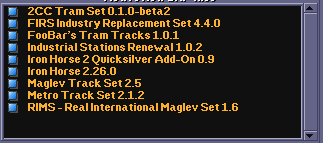
- Road Hog [road vehicles + trams, it's from the same author as Iron Horse and FIRS],
- U&Bridges [like in the name, rail/road bridges],
- U&RaTT [road/tram tracks with speed limits],
- U&ReMM2 [rail tracks with speed limits],
- Av9.8 Aircraft Set [planes, etc.],
- CHIPS Station Set 2.0 [very nice station set which has stations with waiting cargo animations]
If you want some updates for graphics in default OpenGFX, then I suggest adding:
- OpenGFX+ Landscape [removes grid from the map, modifies snow line, enables snow in temperate climate],
- OpenGFX Trees [like in the name, replaces trees and adds trees at the roadside in the cities],
- Stolen Trees [yes, they were stolen at some point, adds very nice trees to the game]
- HEQS [heavy equipment road vehicles, is also good road vehicle set, I'm not sure if it works with all FIRS' cargo].
I remember buying the original transport tycoon (pre deluxe), in a box from Beattie's, and reading the manual on the bus home. Funny how some memories stuck in your mind.
It was the first game I played on a PC! The thing was so slow you had to reboot between playing the game and Windows (3.11)
Trains etc moved in jumps, updating every second. Had no idea it wasn't supposed to be like that till we got an upgrade years later
I remember getting it with my dad all excited because we both agreed we needed more than just the demo. It came in one of those massive game boxes from a locally owned shop (I think) called Disks and Discs. Probably one of my earliest memories that haha
Oh cool, looks like much of the enhancements I'm used to from Joker's pack have been added to JGR. I stopped playing shortly after Joker left, and wasn't keen to going back to vanilla.


The original is a masterpiece when it comes to programming and UI design I think, at least for it's time. It is also very fun :)
It's very nice that it is kept alive in this fashion with openttd.