I just read a fascinating book - Gut Feelings by Gerd Gigerenzer. It's by the guy who did most of the research that Malcolm Gladwell's Blink is based upon. The central thesis was that people have evolved heuristics for decision making that let them quickly make snap decisions more effectively than gathering full information, but a couple chapters were on an interesting corollary: in the absence of hard data on their performance, most people's decision-making heuristic falls back to "Will I be blamed for this decision?"
He provided a bunch of examples from different professions. For example, doctors' decisions often aren't based on solid evidence-based medicine (which is often contradictory), but rather on "Will I be sued if I do or don't perform this treatment?" If you want the doctor's actual opinion, you should ask "If it were your own mother, what would you recommend?" instead of "What would you recommend I do?" - the former shifts the doctor's perspective so that they're thinking "How can I provide the best care?" rather than "Will this person sue me?" A study of UK magistrates found that 92% of their bail decisions could be predicted by the following heuristic: "Did any of the prosecution, police, or previous court recommend bail?" If not, and the defendant commits a crime, it falls into the category of unforeseeable events and the magistrate can't be blamed for it.
A similar effect may be at work with VCs. It's usually impossible to know, even with hindsight, what the opportunity cost of a lost deal was. If a VC turns down the next Google, chances are nothing happens and the company just fizzles. If a VC invests and it goes bust, however, everyone knows. So it pays for the VC to invest like everyone else does: then they can blame any failure on "Well, this was completely unforeseeable: everyone else was sure they'd be a success too." It's the combination of risk aversion, self-interest, and lack of feedback that drives this. If VCs actually had solid conceptual frameworks and good data for evaluating possible opportunities, they could rely on that rather than on their peers' evaluations. (Maybe this explains Sequoia...)
"If VCs actually had solid conceptual frameworks and good data for evaluating possible opportunities, they could rely on that rather than on their peers' evaluations."
This is basically the argument for thesis driven investing. If you Google the term there is some good stuff, especially the posts by Bill Burnham and Fred Wilson.
Ironic that you mention Fred Wilson, since he (or his doppelganger) apparently read drafts of PG's essay (and hence presumably influenced it somewhat).
Comparisons to Google are worthless, primarily for 2 reasons:
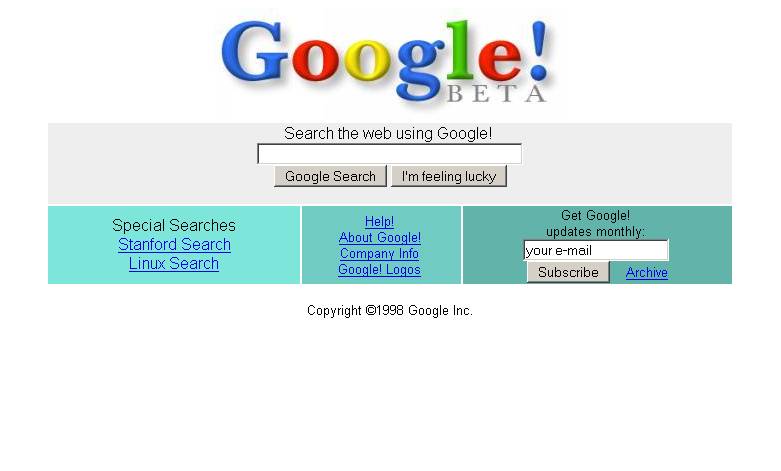
1. Every logical mind (even within Google) in 1999 would have seen that Google was heading for failure - there was no money in search. They got lucky in finding one -adwords - that worked.
2. Had the timing of their discovery been off, or had the dot-com bubble busted a few months earlier, they would have died.
In saying that, they are useless as a measure of anything because they are such an anomaly that they shouldn't be used as a guidepost to success. In other words: If you were to operate the way Google did today, 99 times out of 100 you would fail. They are the exception to the rule.
Although, PG's comparison to Facebook is apt, as they're also in the same position as Google was. I'll put my money on them being in the majority though.
I did like Paul's point about VC's, but then again, you could extend that to how pretty much any industry operates. That's why innovation is so profitable, after all.
1. Every logical mind (even within Google) in 1999 would have seen that Google was heading for failure - there was no money in search. They got lucky in finding one -adwords - that worked.
Lots of "logical minds" invested in Google in 1998. In 1999, Yahoo was profitable; Excite was bought for billions; Compaq and then CMGI tried to relaunch AltaVista. The best ways to maximize search revenue were not yet clear, and many thought the existing search incumbents would be harder to displace, but many smart people saw there was "money in search" and clearly did not think Google was "headed for failure".
Google didn't "get lucky in finding" a model; they looked around for what was working for others. They first tried CPM ads -- "text banners" starting December 1999 -- and later in 2002 moved to Goto.com's wildly successful CPC formula. And they were making money outside of advertising before the AdWords rocket took off.
2. Had the timing of their discovery been off, or had the dot-com bubble busted a few months earlier, they would have died.
Google raised money in 1998 -- so even moving the 2000-2001 bust forward a year wouldn't have put them on thin ice. And the search-linked ads market didn't collapse post-bubble; Goto.com reached strong profitability on search CPC ads in 2001, a "bust year" of very low overall ad spending.
Anything as successful as Google is, at some level, sui generis. Survivorship bias also makes it hard to draw lessons from winners. But your characterization of Google as being just a lucky discovery and a few months' timing away from inexorable failure is inconsistent with the real events of 1998-2001.
Every logical mind (even within Google) in 1999 would have seen that Google was heading for failure
From a make something people want theory of value, they were worth way more than anybody back then. I used to jump from engine to engine trying boolean queries, metacrawlers, keyword mixing, etc, coming up snake eyes.
I think most engines were on the 'portal' kick, which I think meant beating people over the head with banner ads and trying to force them to go to content partners. I think if those sites just stopped for a second and histogrammed what users used rather than what they were trying to force them to do, it would have been absolutely obvious that search was the key.
I remember my search engine of choice was hotbot, because they had advanced search on the front page. And you sure as hell needed advanced search then.
Every logical mind (even within Google) in 1999 would have seen that Google was heading for failure
I didn't think that. I remember telling the powers that be at Yahoo in 1999 (I worked there then) that they ought to buy Google, and it was the only company I ever suggested they buy.
Yahoo's MO at the time was to swap in the current "cool kid" of algorithmic search to fill out Yahoo's own search results. Google didn't really have much of a business outside of selling their results to folks like Yahoo, so I think many logical minds would've agreed that Google was heading for failure--short of being acquired by Yahoo or something other big guy in search.
At the least, you'd have a hard time making a believable argument that they'd be making billions of dollars a year in less than a half decade. And, truthfully, an even harder time trying to make that same sort of argument if they were actually acquired by Yahoo.
Fair enough Paul, but I think we've already proved your as much an exception to the rule as Google is. :-)
My point was that "most people" would have considered Google a bad investment prior to adwords. Given the response, it's obvious I should have been more clear.
Well, or they fail spectacularly and we turn their business model into a running gag. But then, most "Googles" seem to have a business model that would have been a running gag had it failed.
True. Causality vs Correlation. I would imagine that many if not most big successes had an acquisition offer along the way but could it be that becoming a google, apple, microsoft or oracle is much more a function of good strategy, good execution, good markets, good timing and good luck than a function of an entrepreneur walking away from an acquisition offer?
This is true. However, I think the point being made here is that while you need strategy, execution, timing, all of the things you just listed above (and more), even if you have all of these things, you still can't become "a Google" if you don't resist early offers.
I've been quite surprised by the "get more traction" argument. It's like, if I had traction, what the hell would I need you for! Aren't you supposed to be the cowboys of investing? Sheesh. Tell me my idea sucks, that I suck or that my market sucks, anything but "your company doesn't exist yet so we can't fund it." Sort of a self defeating argument.
When I pitched my previous startup, a few years back, VCs made us jump through those standard hoops:
us: here's our Powerpoint presentation
VC: nice concept, come back when you have a product
[1 year later]
us: here's our product, let me give you a demo
VC: nice product. Come back when you have one customer.
[6 months later]
us: great news, we just signed XYZ, Inc. (big name) as our first customer.
VC: congratulations. Come back when you have traction (that is, multiple customers)
....
True story. We eventually got funding, 3 rounds. In another post, I'll discuss the other lesson I learned in VC funding: don't raise money when you need money.
Heh, I get the same thing. I am launching a service based business. Someday I am going to thank the 25 VC firms that gave me that "more traction" statement as I bootstrap the business.
Investment and acquisition issues aside, the reason there aren't more Googles is because... there aren't that many Googles. Their mission statement is huge: "organize the world's information. From the get-go they had a unique algorithm that could do it. They just needed money to keep expanding their infrastructure.
I'm not convinced there are many bold, innovative founders with world-changing inventions that are falling through the cracks. The genius maverick entrepreneur is mostly an imaginary romantic archetype. Many founders these days seem as conservative as investors if you compare the scope of their ideas to Google, Apple, Ebay, Skype, or other projects that did change the world. The modus operandi for founders these days seems to be "aim sorta low and cash out early."
We recognized this gap in the capital for young companies a while ago when we started Tandem Entrepreneurs and I could go on about this in great detail. However I will just highlight that the gap isn't just with financial capital, it is with human capital too. Beyond the founders, there are very few who would join these startups as employees? Why wouldn't a talent entrepreneur not just do his own? The basic equation of go raise some money and then go hire people breaks down.
Moving to risk, they key driver here is that investors must take themselves out of the equation when investing.The company must make sense even if they are not involved. This makes them cautious when things are still iffy. Tandem address this problem through a co-entrepreneurship model. We invest both human and financial capital. The human capital is to find our way to clarity together. This gives a greater comfort in taking risk. We feel much more like an entrepreneur.
Of course the Tandem model is not very scalable; we can’t even do the 30-40 that YC will do. We do a handful a year and only where we know our human capital will bring an edge.
I don’t think the VC’s have much incentive to do a co-entrepreneurship model, when they can make nice salaries doing what they do. It is obvious in hindsite that the short haul model of Southwest Airlines was a good business but it was a long time before the incumbent airlines paid it heed. I wouldn;t hold my breath for the VCs to change.
"the kind of founders who have the balls to turn down a big offer also tend to be very successful"
Or they tend to fail spectacularly. The more risk you are willing to take the more you will tend to go towards the extremes: One extreme is huge succes, the other is bankruptcy.
Absolutely agree. I know more people who have turned down big offers and ended up with $0 than people who have gone on to tremendous success after turning down an offer. There are definitely other variables involved. But I would guess:
P(COMPANY TURNED DOWN BUYOUT OFFER(S) | COMPANY BECOMES LARGE SUCCESS) = 1.
But the reverse wouldn't be as good a predictor as PG feels.
You guys are confusing competence with confidence. If you're riding a motorcycle really fast, would you rather be confident with yourself being able to control it, or would you rather be competent?
People who go all in are not always just confident, and bold, but also might know what they're doing as well.
The challenge with the $200k-$500k funding gap is the fact that most VCs make funding decisions by partner consensus.
After spending the last 8 month trying to put such a round together, and going through the process with quite a few VCs, It's apparent that this brings 'boldness' way down because all the lead partners need to develop the intuition necessary to be bold-- on what is essentially a hypothesis on market development or consumer demand in a field that is usually not their individual core expertise and in the short time frame that this business allows nowadays. doesn't happen often.
This is why these sort of investments are made by small/ partner-lean funds or through the "strong" partner in a more traditional firm... and there aren't enough of those.
It's not that they don't want to make those sort of investments, its that they're not setup to do so. In our discussions, we've gotten to, at several occasions, a point where our sponsor partner is actively trying to get the deal done, only to fall apart because of this need for uniform consensus of the entire clan.
If I were a VC, I'd focus on streamlining that process through more partner independence as I agree that this is the sort of funding a truely innovative (particularly web software) company needs to establish itself these days and they are mostly missing out...
I am seriously having issues visualizing someone saying "this is not a good idea" to google founders. Perhaps I am too young or perhaps S&L were terrible salesmen, but I simply fail to see how come a relevant search seemed like a bad idea to VCs they talked to: and this is not 1995 we're talking here, back when Google was starting it was clear to many that everything was going to be online, and finding stuff will be hard, this is why everyone was into catalogs/portals.
Maybe I am too much of an "idea guy", but in my opinion the reason why there aren't many googles is simply because there aren't many good ideas around. I don't even consider social networking to be of any significant value (I'm with Maroon on this one). In that regard it was awkward to see Facebook and Google mentioned in the same sentence several times.
Even something as awesome as RSS isn't taking off (and it's been like 5 years already), let alone toys like Twitter that only a certain "inner circle" of people are using talking mostly to themselves. Not good enough.
Yes, yes - "implementation is more important", but without an idea there is nothing to implement to begin with. Most startups I know a little bit about seem more like an excuse for smart and driven people to work together: they aren't building anything particularly innovative. An no, they won't become next google regardless of what VCs or potential acquirers will do, it's a very rare case where I don't agree with Paul at all.
..on a business card printed out from a laser printer on ordinary office paper. The guy pushing this on you is some grad school dropout with a strange voice who keeps saying he's going to change the world.
Google will be obsolete once the semantic web arrives ;)
I remember being pretty skeptical of Google. Better search seemed like a nice idea, but it wasn't clear how they were going to compete with the established players who all had more money, more users, more engineers, more features, etc. Also, Google wasn't the only company trying to build a better search engine. It seemed like there was a new one every month.
How did you bump into Google, coming from the middle of the country? What made you get over the initial skepticism and join? (If you don't mind me asking.)
The rest is history. I was interviewing at Altera and Xilinx at the time. Never would have occured to me that something that big was brewing not to far away.
This essay doesn't quite sit right for me. My skeptical side constructs the message "invest 400k in YCombinator startups and you will have a piece of the next Google."
I think I see that because I assume that PG is not being hypocritical; ie. VC's should make bold investments -> YCombinator must already be making bold investments.
I am not under the impression that this message is intentional, it just seems that the argument flows to that point.
I was hoping for examples of YCombinator companies to go with each of the arguments about success (or failure, but that might be picking on them). That would have bolstered the assertions and made it sit better with me.
I agree with your point here. Some ideas seem so radically out of touch, that they actually are out of touch. The founder of Intuit once said that 'your competition isn't other companies, but the way things are done now'. Some companies like to invent ideas about what people actually do. Therefore: observe how people spend their time, and make something that makes that better or more valuable. Then you can make sure you're not making something 'actually bad'!
As Niels Bohr (to Wolfgang Pauli(or vice versa)) once said,
"We are all agreed that your theory is crazy. The question which divides us is whether it is crazy enough to have a chance of being correct. My own feeling is that it is not crazy enough."
The article makes some good points on the effects of funding on startup success, but it doesn't mention one the
"other" reasons there aren't more Googles (or Microsofts, or Ebays): huge markets that startups can disrupt so successfully are rare. Facebook, for example, which is probably the biggest startup success story since Google, could be doing everything right but it may never be as big as Google because it's playing in a smaller market.
this article makes the good point that the mba types who are running vc funds are fundamentally ill-suited for identifying and investing in technology startups. paul graham identified this as true for managers of startups as well; and this is a defining feature of yc--investing in technology people vs. investing in mba types who hire programmers. of course, the logical extension is that the people doing the investing themselves should be technology people because they alone can recognize value in the technology sector. whatever value mba vc types did bring to the table, understanding of business management and such, is becoming less relevant with smaller startups and less money to be allocated.
whatever value mba vc types did bring to the table, understanding of business management and such, is becoming less relevant with smaller startups and less money to be allocated.
I completely agree. The answer isn't to convince VCs to invest in companies they aren't suited to be messing around with. Something new needs to happen. PG pointing it out to outsiders should help the free market in the right direction...
whatever value mba vc types did bring to the table
I still don't understand how they are valued at all. They don't invent anything, don't know how to help people who do, and are often bad at caretaking what has been built.
This is not meant as a swipe at them, but I honestly do not understand why they are highly valued.
Because, at least according to a handful of VCs at DFJ, 70% of the work they do involves interacting with and convincing other people (usually people who can help their portfolio companies in some way, shape, or form).
In general, MBAs are better at this than those with technical training.
Further, a VC doesn't have to understand the intimate technical details of an opportunity to recognize that it is a valuable opportunity.
I'm not saying this makes for a good relationship with your VC, but that's why the equilibrium set of employees tends towards MBAs instead of PhDs.
However, I think you'll find that many VCs in the top-tier did engineering at undergrad, then got an MBA.
Just look at the CVs and salary data (if available) at any VC firm, or, outside of the startup world, grep for median MBA compensation and compare it to any tech field median salary.
Perhaps an enterprising Angel Group can try to package or commoditize the process of making Angel-sized (six figure) investments. I'm not sure the term "Angel Group" would still apply after adopting this model, but Angel Groups seem well-positioned to evolve into this new "new venture animal."
Traditional angel groups have so far been a complete disappointment. They're more conservative than VCs.
But I would not be surprised if a new form of angel
group starts to emerge. There are a couple syndicates of ex-Googlers that look very promising. They have lots of money, and they were all smart enough to get hired as early employees at Google.
It is my understanding that Angel Groups presently serve more to facilitate connections between Entrepreneurs and Angel Investors, rather than investing collaboratively. The size of the investments they facilitate vary (likely to fall between seed/YC [5 figures] and VC [7 figures or +] sizes).
It's great to hear discussion around Umair's thought patterns that add even more depth...
I think what he was trying to say might be a little different from PG's interpretation...
Umair might have said, "every company that had the potential to be economically revolutionary over the last five years sold out [to an acquirer devoid of strategic imagination or the capabilities to discontinuously continue their trajectory]," ergo ending the disruption gravy train.
That is, it's not necessarily "selling out" that blows things up; it's selling out to companies only driven to "increase market share", etc.
Or something like that.
I also think it is really interesting how your view of how the GOOG acquisition/IPO story played out vs. Umair's version:
"If all Larry, Sergey, and Google's investors had wanted to do was to sell out fast to the highest bidder, they could have done so at any time. But they didn't: they chose to revolutionize something that sucked - and so a tsunami of new value was unlocked."
That clearly doesn't square with how you saw it (even though it's an inspiring revision). I unfortunately lost my copy of Battelle's book before I got this far in the story, otherwise I would weigh in.
Clearly PG, Fred, Umair, and other smart ones agree on the need for more, smaller risks and purposeful management.
At any rate, whoever these "new investors" are that are going to fill the void between bottstrapping at Series A are going to make a FORTUNE. And they can't show up soon enough!
I totally understand them...they were in a position to pick a number that said, "You know what, if someone actually puts this up, we can take the deal and have absolutely no regrets."
[If this stands to reason], it wasn't "outrageously high because they didn't want to sell"; it was just the true price.
They knew how enormous GOOG's potential was and acquirers didn't, hence the asymmetric information situation that leads to your thesis that "turning down reasonable offers is the most reliable test you could invent for whether a startup will make it big."
I disagree Google had a number. It was clear from many stories that they were really not interested in selling at all, so they would throw around some outrageous number (knowing it was outrageous), so nothing would happen.
Calling such a person a seller-but-for-the-price is incorrect, IMHO.
The reason there are few Googles or Microsoft's, etc. has more to do with the structure of competition and markets than it does with the factors outlined in your essay.
The reality is that the companies that grow largest are those that foster the growth of an eco-system of smaller dependent companies. The large "focal point" companies, by the nature of their particular market disruption, create opportunities for others to grow new businesses or do old businesses better. But, at the same time that they create opportunity, they limit it (intentionally or not) by ensuring increased competition for the dependent companies.
Creating opportunities means lowering barriers to entry and lowered barriers means increased competition, lowered returns and limited capacity to grow as large as the "focal point" or "platform" company that creates the opportunities.
If anything, VC's have been too liberal, not too conservative, in funding companies. I recently wrote about this at some length. Please consider reading my post at:
http://bob.wyman.us/main/2008/04/liquidity-and-c.html
Instead of making one $2 million investment, make five $400k investments... If you're investing at a tenth the valuation, you only have to be a tenth as sure.
I don't agree with this. The investors have to be just as sure of the risk involved in each valuation as before in order to have the same expected value for the overall portfolio. However, investing $400K in 5 companies instead of $2M in a single company will reduce the variance of the return on investment.
I think it's a tradeoff for the VCs between variance in the portfolio and the amount of work involved in finding 5 times as many companies. Given the amount of funding they deal with, I can understand them leaning towards the companies looking for $2M rounds.
It seems obvious. But I've proposed to several VC firms that they set aside some money and designate one partner to make more, smaller bets, and they react as if I'd proposed the partners all get nose rings.
As I pointed out above, the partner has to be just as sure of each of the 5 bets as he would be of one. I'd react the same way if someone suggested I'd do better at my job if I worked 5 times as hard.
Suppose your threshold for investing in a startup is an n% confidence that they'll one day have a market cap of a billion dollars.
Suppose instead you split that investment between 10 companies at a tenth the valuation. How confident do you have to be that any given one will become a billion dollar company? You have the same percentage in all these companies that you would have had in the case of a single, big investment, so now you only need one of the 10 to succeed in order to get the same return.
There is a tradeoff though--accepting a smaller probability of success increases the variance, which deterministically drags down the returns. To see the effect, extend your argument to the extreme case of very very early valuations. You have $100k to invest, and you invest $1 each in 100k companies, each with a 1 in a billion chance of being a billion dollar company. Though your expected value is the same, at the end of the year, most likely you have no money left to invest for next year. The same effect holds in less extreme cases--if you increase your variance and lose 50% of your money, you can't just make it back by having a 50% upswing the next year--you need a 100% return to recoup it. So variance matters.
This makes complete sense if you assume that a company that only needs a few hundred thousand to "figure things out" has an equal chance of becoming a billion dollar company as a company that is looking for a multi-million dollar investment that "is already taking off." That's evident to us inside, but your own description of the companies is enough to make a VC understandably skittish.
I understand your overall point, and I agree with it, but I don't think this assumption was clear the first time I read through the article.
I wholeheartedly agree that convincing VCs of this isn't the way to go, and that others are going to make a killing by stepping in. My main point is only that the VCs aren't being irrational.
VC's likely believe lowering the dilligence and involvement level lowers the likelihood of success. If VC's believe, rightly or wrongly, the success rate drops from 10% to 5%, then by lowering selection criteria and involvement, they've lowered the rate of return by diversifying into a pool of lower quality. The key is whether those things really matter. In justifying their paychecks, however, they are vital.
> Suppose instead you split that investment between 10 companies at a tenth the valuation. How confident do you have to be that any given one will become a billion dollar company?
You'd have to be more confident in aggregate.
Let's say in the former case you have a 50% certainty with one company; and in the latter case you have 5% confidence with each of 10 companies.
The chance that NONE of them succeed to that degree is 0.95^10, or about 60%. So only a 40% chance someone will make it, vs. 50% for the former.
With smaller probabilities the difference is less, but guesstimating at billions is such a crapshoot. How about something more realistic?
How about doubling your money: Let's say you put $1 mil into the former company. If it doubles its worth, you've doubled your money. But in the $100k for each of 10 companies case, they all have to double their worth, or one has to grow 20x.
Let's say you think it's a 50% safe bet in the former case, but a whopping 90% chance in the smaller cases. The chance they ALL double up is 0.90^10, or about 35%. So you're probably losing money.
Sure, some might do 3x or 4x to make up for a couple of the flops, but you probably aren't going to let a 100k investment just die; you'll be sinking more into the money losers, so the successes have to do even better to make up for the bailouts.
"The low cost of starting a startup means the average good bet is a riskier one, but most existing VC firms still operate as if they were investing in hardware startups in 1985."
I don't understand the idea behind this sentence. In this context what is a good bet, a company with certain traits or does this refer to a certain type of portfolio strategy, say one that expects most startups to fail and a few to win big? Also, how does the falling cost of startups make the average good bet riskier? Is it because it lowers the barriers for competitors? Or is it because any idiot can say they're doing a startup so it's harder for investors to know which ones are good and which ones are bad? Also, what was investing in hardware startups like in 1985? Are you saying that VCs today evaluate companies with low capital requirements and high risk as if they are capital intensive with low risk? This has multiple implications, and which one(s) was in your head when you wrote this is not entirely clear to me.
Hardware companies are not inherently low risk because they involve hardware. They are often, in fact, capital intensive and high risk. See early PC makers, telecom bust, pen computing, etc...
My thinking was that it might be easier to judge the risks involved since starting a hardware company usually requires getting an EE degree and then spending several years learning by working for an established company. Whereas since it is possible do a successful web startup with no previous experience or credentials, VCs have less data points to evaluate the chances of success.
In any event, this debate only underscores my point about the clarity of the sentence in question.
So far, the "design spec" for the next-generation vc seems to be:
1. Invests $250-500k
2. Gets back to the applicants with a yes/no decision in 24 hours (can't find the pg essay).
I'm thinking there should be some kind of software, an algorithm, to help such a vc make decisions... what kind of factors would be part of it, and what else would be needed?
So the biggest gap is between angels/yc clones and VCs? It appears that there is a far bigger disparity between potential startups and angels who will fund them. This may be hard to grasp, depending on where you sit, but there is still a truly microscopic percentage of the workforce that gets in at the ground floor of a startup that gets funded by outside angels.
This is to say that percentages are what should be considered in measuring "ease" of getting an investment at each stage. 0.001% of groups that desire an early stage angel investment can get it, 30% of angel funded groups can get a successive intermediate investment, 50% of the groups that make it to the intermediate stage can get VC money, etc.
It's pretty clear that VCs are more like hedge fund managers than their name would indicate. Hedging, trend following, even arbitrage are more important to maintaining the IRR of the fund than developing innovative companies. This is by necessity, rather than by preference, I imagine. No Managing Partner will or should allow significant bets to be placed on the roulette wheel of technology, no matter how interesting or exciting, when the entire fund, and the livelihood and reputation of the partnership could be at stake.
A possible solution is to expand the availability and amount angel/seed financing available to entrepreneurs by an order of magnitude, or more. This could be done by creating a quasi-public market (offshore, since the SEC wouldn't even consider it) that would allow individual investors to buy small pieces of early stage companies.
Individual small investors with a high tolerance for risk and a more certain knowledge of technology, innovation and particular industry sectors would form the basis for this new financing engine for startups. Companies would need to publish some kind of prospectus and they would also be rated by the number and quality of current investors, who would also be ranked.
This is not unlike the angel networks of today -- but would take the model to the next level by allowing millions of individual investors to participate in the $1,000 to $10,000 range in each venture.
it's like rock bands that sell out to major labels for big advances and then sell like 10,000 records and wind up owing the label. and you know the LABEL ruined the band.
good web startups aren't about money, they're about building something new. as fugazi puts it, "when we have nothing left to give there'll be no reason for us to live". basically, google was JUST GETTING STARTED and they KNEW it - they were following a brilliant brand into the infinite sun with no knowledge of how they'd milk it until all of a sudden the answer popped into their (well Bill Gross's) head.
so selling out means you're done developing the product. that is cool if you go design something else, but generally, the product winds up being dead on the vine. big companies buy small companies to scare and posture at other big companies and grab a few headlines.
in order to get acquired, you've got to have a "hit". some bands are one hit wonders. these bands like to work with major labels, which is OK if it makes the radio a bit cooler that summer (cf Cracker). but the major labels buried the Gang of Four, just as surely as they'd snip Twitter's in-house innovation capacity in the bud. That said, if the Twitter guys are "done" with innovating, good for them, go ahead and exit! but i hardly believe Twitter is done developing their product. therefore, NO SALE, and the chance for Twitter to unleash a bidding war for a tiny sliver of equity such as what was engineered by Facebook.
This has the sense of a ploy to spur on companies to buyout for huge amounts - furthering YC's interests. Also suggests VCs should take on more risk - furthering YC's interests. Urges entrepreneurs to hold out even longer - furthering YC's interests (if these entrepreneurs are in YC).
I don't disagree this message - but the motivation for writing this seems extremely transparent.
Not every buyout makes sense. Buying out Facebook for the valuation given to them roughly by the MSFT investment looks ridiculous considering Facebook's inability to monetize their traffic.
VCs fundamentally are trying to be risk adverse in a high risk environment. They all want to have a slightly higher success rate than average and do great.
Entrepreneurs always will hit a point where it makes sense to sell out and get rid of the risk on their end of holding on. If you have a portfolio of 100 companies, it makes sense to want each to hold out as long as possible. If you have one company you own a major stake of, it makes sense at a much lower value to liquidate.
I agree. I recently presented at a local angel and VC conference. Many people believed in our idea, but we were asking for $500K. I already had a high profile company who had already signed an agreement to conduct a trial with us. The $500K was to be used for the trial as well as marketing. I got the same comments about traction, looking for later stage companies. At this point, I would rather take a loan out from a bank or arrange some creative funding than go to a VC again.
I think sometimes it really comes down to guts. We can all site and do the risk analysis on a good or bad investment, but a gut call has to be made in the end. I think for one reason or another most VC's have lost the mindset. It may also be the change in the environment. The dot bomb may have left serious psychological impediments that most VCs do not want to relive so they shy away from these investments even though it can provide sensational returns.
Something about this article didn't sit well with me (as with others, judging from the comments). It felt awfully like "Too many YC companies are out there looking for that $300-400K, but not enough takers, so the VC system sucks" kind of argument. To turn it around (and to be the devil's advocate), perhaps too many YC companies aren't finding takers because the investors don't feel confident - for whatever reason - like the looming downturn or that they are in too small a niche or they will find it difficult to find independent traction against more well-endowed players or whatever?
What percentage of YC companies launched till date (launched means the initial YC funding is exhausted) that haven't found angels or VCs? That would prove instructive.
Contrary to what you may heard, while it may be good to start in the middle of a downturn, it is no fun to try to last through a downturn if you are "pre-revenue" and have no investors.
> The reason there aren't more Googles is not that investors encourage innovative startups to sell out, but that they won't even fund them.
The core problem is how investors are compensated. A managing partner's performance is directly linked to how many bad deals they avoid - avoiding "true negatives", minimizing "false positives". Because of this performance metric, investors are risk-adverse and I can't blame them for it. If we want innovation to be funded, the LP's need to tweak how the managing partners are measured. Managing partners are paid for their "insight" into emerging industries. Well, then penalize them for great deals that they passed on - the "false negatives". They should be accountable for the "false negatives" as much as the "false positives". That's what they are paid to do.
"They're riskier - so you just have to spread your money more broadly."
Where have we heard that before ? Oh right the financial crisis.
I don't think more startups translates into more good ideas. Just in more copies and more bad ones. Therefore the cheaper and more plentiful companies get, the more risky they are, and the fewer chances (less funding) really, really good ideas get.
But it's fashionable to startup. So a number of people are putting their "look cool" money (which is often the same type of money Obama spends : someone else's, and therefore plentiful and worthless to them) into little startups who are very sure to fail.
As always it is a very thoughtful and incisive article. However, I have certain reservations on Google trying to sell out, especially after I read The Google Story by David A. Vise and Mark Malseed.
I believe for young people (especially tech students), the idea is not to make a lot of money. It is more of a passion, a will to change the world. Yes, they may have failed as well. I may not say the same for people who are in the industry for long or MBA types.
Interestingly, I just went to a talk last week talking about how angel investors are learning to fill that gap in the funding space (http://blog.nextny.org/2008/04/11/the-insider-secrets-of-ang...). They are banding together into groups, and using a common backend platform (AngelSoft) to make it easier for angels to evaluate investment opportunities. Admittedly, the speaker was the CEO of AngelSoft, so he's biased (they've identified the funding gap as a market opportunity and moving towards exploiting it). Seems like an interesting possibility.
I don't think there are more Googles out there because there aren't that many good ideas floating around. Yes, things move quickly in the age of the internet, but the truth is, if there were more ideas as good as Google, there would be more Googles. Duh!
It isn't about money or funding or even execution. It is about innovation and timing. Give it time. If someone has a Google worthy idea, it'll emerge because people with copy it, steal it, hack it, flame it, etc.
Or maybe it's because Google hired all the smart people and now they own anyone who has the potential to create another Google like movement, so all the VCs are doing are throwing good money after bad ideas.
I think this is really simple answer on the question why VCs are so conservative. They barely understand business they invest in. That's why they look for traction so much! Traction is just a mix of financial metrics, and that's what they really understand. Before you can show a hockey stick chart showing number of visitors, or better revenue or profit, there is no real interest from VC side.
I think the reason why angels become a real drivers of innovation these days is because they invest pre-revenue, and the reason why they do it is because they understand the business they invest in and play an active role in it.
I didn't have time to read though all comments, however, it appears to me that Google has a very strong and unique culture that is often credited for contributing heavily to the company's success. How does this factor into the why aren't there more Googles question? I don't hear the same things about Facebook so I wonder if in 10 years will they still be mentioned or spoken about in the same vein? In any case, the reason I mention this is because it seems like a very difficult part of a company to place a value upon. Perhaps this is why "Googles" escape acquisition...
As noted above, the VC firm Charles River has a seed fund that invests $250,000 per deal:
www.crv.com/AboutCRV/CRVQuickStartFAQ.html
This is a brilliant idea! Ycombinator has been a true innovator -- they saw a gap in the capital markets, they had the guts to go out and fill it, now a lot of guys are copying what they do, but they will always enjoy first mover advantage. Charles River is doing the same thing, filling a gap that everyone knows exists but no one so far has actually filled.
One of my reactions to the Ycombinator standard approach -- $15,000 for 3 months of funding -- is that 3 months is a very show time frame. I am pretty good at what I do, I frankly have a lot more experience than the kids who get Ycombinator funding, I typically work about 70 hours a week, and I know I am quite productive at what I do. I don't go for home runs but at the same time, I don't go for singles. I go for doubles, that is a risk/reward range I am comfortable with. I find it takes about 12 months to get it running reasonably well, and I have done it several times before. I would not want to work on a 3 month time schedule. If I did, I would be going for singles and singles just are not that interesting.
To me, a single is a deal where you end up with $1 million cash out after two years. A double is $5 million after two or three years. A triple would be north of $10 million, no later than four years. Anything north of $25 million is a home run. Anything above $100 is a grand slam home run.
I do not need financing, I just fund them myself, but if I did, the Charles River deal would be much more appealing. Assuming I needed the money, with $250,000, I could get two partners, we each pay ourselves $60,000 a year, perhaps burn up another $50,000 in expenses in one year, for a total burn of $230,000,leaving us $20,000 margin (admittedly, not a lot). But in one year with two really good partners, we could do a hell of a lot of work, perhaps a triple rather than a double.
I really like what Ycombinator is doing but so many of their investments seems unambitious -- two smart college students who whipped something up in a month. Perhaps they might build a company from that, but in some cases, I am skeptical.
It's the longtail of investing.
The secret will always be in the filter - how to seperate the wheat from the chaff.
Right now people wait to see what survives.
How does one do this better? No idea - but let us imagine that we can use The Wisdom of Crowds.
Maybe the trick is to build operate and own an exchange that performs some level of due diligence on the companies and lets people - us, the great unwashed - invest micro amounts via paypal or similar methods. Of course there will be frauds and fools, but let the people decide how to establish 'trust mechanisms'.
How many startups are seeking out the new, untested, crazy!, VC firms as opposed to the ones with the established track record of blockbusters?
If you expect the VCs to be hip to the 'new era' of investing, then perhaps you, as a startup, should show your own hipness by not showing up at the door of Kleiner Perkins, or Sequoia. A true show of your own non-conservatism.
And remember, the expectations for startups and VCs are reversed (which would seem to explain much).
Startups are expected to fail, and its OK if they do.
VCs are expected to succeed, and its NOT OK if they don't.
It is very interesting to learn that VCs also demonstrate herd mentality or group think when they invest. The same behaviour is also displayed by professional money/mutual fund managers.
I remember reading somewhere the statistics that VC funding during the dot-com bubble days was at its peak. So they were not any better than the individual investors in terms of assessing these dot-coms for their potential. And the common reason VCs gave for those investments was that they knew it was a bubble but they did not want to be left out of the deals.
The problems are as much in the beginning as the endgame. I agree that Umair has it wrong. And I like spreading the net wider. But, all deals are not cheaper. Google spent a fortune on early R&D, and the world has moved away from that model, hence reducing the likelihood of building something hard with real barriers to entry.
As a UK business who are setting up 'the next google' what you say is painfully becoming obvious. The people with the money see us as 'too risky', basically they are really stupid.
We've had to become super sales guys just to get them to even listen to us or even read the Executive Summary!
It's a strange and bizarre journey. Great to read what you have said, it confirms what we thought.
I suppose the strategy is to focus more on Angel Investors - something we need to look at more now. www.ibodnet.com
You made the right decision. The big point everyone here seems to be missing is the diminishing value of money. If you sold for even $1 million, that's enought to live off interest for the rest of your life.
This is so true. We are a startup and have had to increase the amount we're asking for to get any interest. Really, a few hundred thousand would take us miles, but we have to ask for 2M to get in any doors. And even then, we get lots of "get back to us when you have more traction," just as the article states. Bad news, VCs: we won't need you when we get more "traction," because we built monetization into our business model, as a lot of start-ups are now doing.
I attended a great session by David S. Rose, an angel investor and partner in AngelSoft (doing great things in the Angel Group investing world) at BarCampMoneyNYC a couple weeks ago and learned that Angel Investors and Angel Groups are usually the stage between startup and VC. They are more willing to make smaller investments in less-proven ideas. By the time a company gets to VC stage, it needs to have a pretty well established.
The "another tip" part where you articulate how companies should let startups be run by founders is actually where the difficult part is. I am not sure Google would be "Google" if it was absorbed into a large company - it would be a search feature.
On that, I recall VCs telling me often when I shared an idea: "This is not a company, this is a feature". I think Search is a feature. Isn't it? So is RSS, Widgets, Contact Management (LinkedIn), etc.
this is a great post. It rings so true. We are a nearly ten year old technology firm that has spent years of laser light focus on our product. The venture industry is a herd that cannot understand innovation if their lives depended on it and seem to care more about the politics of the venture world rather than spending time to learn beyond the ridiculous 'elevator pitch'. God forbid you say your technology is a major innovation and will change an industry - I think they all would rather have a weather widget on Facebook than actually shape an industry. I sometimes wonder if VCs are so drawn to the Midas 8 from Google (which is 10 years old and getting dusty up at the top) that they emulate the investment strategy of this lucky few rather than finding their own path. Our company is now talking with Wall Street firms about raising $100 to $200 Million over the next few months and smart money is betting we have created a $50 Billion industry that never existed before. We find it comical as the street has embraced our company while the VC community continues to chase the "me-toos" while talking the talk.
With so much activity on YC last week regarding FaceBook - it should at least be mentioned that one good reason FB is garnering a $15 billion valuation is they had the confidence/balls to turn down the early offers.
Microsoft noticed and placed their bet accordingly.
If you turn down one billion and keep growing, then you get a much higher valuation the next time around.
Paul, I don't see why would a startup even need $400k in its initial years. After all, isn't the average startup just a few friends working out of someone's basement? At the max their costs include a rented apartment, computers, a few air flights & food.
I am sure I have missed out something big, what is it?
"Plus most of them are money guys rather than technical guys, so they don't understand what the startups they're investing in do."
Yes, and if they were technical guys, they would for the most part be certain that the startup is doing something stupid. Take for example the typical techno-geek reaction to hotmail or the iPod.
Monster Venture lead by Robert Monster is a very good $100,000 to $200,000 investor. He sees value early on and really lets the founders make the most of the potential startup. I know, because we are one of 18 companies he invested in 2007.
That was a very well thought out and written essay. I invite you to look at and join if you feel so inspired a new site called Thinklike. The address is: http://www.thinklike.net.
AGE is the reason. SOFTWARE is the YOUNGEST OF ALL SCIENCES.
I doubt that the reason has a lot to do with valuation and acquisition. The simple reason is AGE. the WEB is still young. Seriously the web is really less than 20 years old. And please do not tell me that NASA and the NSA were using the internet 50 years ago. Medecine has been around thousands of years. Same for Architecture and Mathematics etc..... But the science of Computers and Computing is still an INFANT. Whether there are more acquisitions in the future or less, there will be tons of more Computing Innovation just because the field will MATURE. We still have not grasp the full potential of this field and frankly i think Google is just a drop of water in the ocean of possibilities.
"Tip for acquirers: when a startup turns you down, consider raising your offer, because there's a good chance the outrageous price they want will later seem a bargain."
VCs appear to be just like the rest of us: risk averse and with a fear of failure. I bet they put on their pants one leg at a time, too. Thanks for the wake-up call.
Quoting from John Battelle's book on Google,"...Page set the price at $1.6m, but Excite CEO Goerge Bell threw Vinod Kholsa out even at $750,000..". That was c.1998.
> The reason there aren't more Googles is not that investors encourage innovative startups to sell out, but that they won't even fund them.
This goes for YC as well. Surely there are some technically innovative applicants that don't fit the mould of web sites to make quizzes or 10-second cartoons or other such dubious acceptees.
Google itself would have been rejected on at least a couple of grounds: project being too big to make much progress in 3 months (crawling the entire web!), and needing too much money ($15k ought to be enough for anybody!). IIRC they got not only the $100k from Bechtolsheim but also a similar amount from Cheriton.
> And yet it's the bold ideas that generate the biggest returns.
Yet YC sticks with smaller ideas...
> It's remarkable how wedded they are to their standard m.o.
This also seems to apply to YC. Small idea, $15k, 3 months, move your ass to Boston (then move again to SV, where you should have been in the first place), standard terms, no negotiation of the offer if YC accepts you.
I'm curious: Where does the $15k number fit into that? At one point it was explained as "this should be enough money for you to live off for three months" -- if you're funding groups which take 2 years to launch, how are they supporting themselves for the remaining 21 months?
From your previous letter: "We rejected a lot of proposals [...] because the project seemed too big to start on only three months of funding."
All your non-defunct fundees are still "building", but that's not the same as accepting groups you know are going to take two years and a lot more funding right at the outset.
As for caring about the founders/investing in people instead of ideas, that doesn't hold up for several reasons: 1) If you really end up changing the idea so often anyway, as often claimed, the idea proposed wouldn't be grounds for rejection if the founders were otherwise good; 2) Many founders don't have track records, thus you have nothing to judge them on; 3) Some applicants do have track records, but you reject them without reviewing the stuff they've done due to lack of time or other reasons.
That sentence isn't in the most recent emails. I took it out precisely because it's no longer true. It was in the rejection email we sent the first summer, and as often happens with text you rarely look at, it stayed around after it had become false.
And by building, I meant two years to launch. There's a startup we funded two years ago that's launching in late spring or early summer.
It still doesn't make sense. You say two years ago you had this max-timeframe criteria; but there's a startup you funded two years ago that has yet to launch. Well, you can't use them as an example of your foresight if they accidentally slipped through your filter, or if they accidentally ended up taking much longer than expected. Fo' shizzle, G.
It's kind of amusing the rejectees not only got a form letter, but a recycled one, which wasn't even accurate!
Probably not. I turned 40 last month. I find that I'm much less likely to write the wrong year on my checks than I was 10 years ago. When you're younger, what year it is seems permanent, hard to change. Later you're no more likely to forget what year it is than you are to forget what month it is.
Heck, I'm only 24 and I was just noticing that the other day. I remember when I was in second grade, and the year switched, I put the wrong year for months. Now the turning of a year just doesn't seem that momentous anymore.
I wonder why time seems to accelerate as we age. Is it because we are more busy, and hence spend less time being bored? Or is it somehow related to the fact that any given year's memories are an ever shrinking percentage of my overall memory store? If I were rich I would study people's perception of time, because it seems so non-linear.
I think it's largely the latter. When you have fewer memories, everything is newer, so each moment is more vivid. As time seems to slow when we have adrenaline rushes, the same with vivid experiences.
I think what's being overlooked by the article is the actual development of some good technology -- there seems to be so much focus on the exit rather than what a startup is actually doing.
So many of these Web 2.0 startups seem to want to grab a piece of the pie by diverting traffic rather than growing the pie by offering something fundamentally useful.
Great write up, agree 100%. My startup (getclicky.com) was seeking around $100K about a year ago. We talked to a lot of people but could only find anyone who was interested in a very small (<10K) or very large (>1M) investment. That's not what we wanted. At this point we have not taken a cent of investment and it has worked out fine, we're doing great on our own and it feels nice to own 100% of our company. But there is definitely a market for this medium sized investment that is not being fulfilled at all.
I come from another perspective, I have lost absolutely all faith in investors period.
In the early nineties (during a recession in the UK) I started my passion and dream of building a design, manufacturing and distribution company. It was one hell of a chunk to bit off. Imagine 2 years design period, manufacturing cycle is a min of 6 months from ordering components to final assembly, then you have to spend on marketing and get the product into the shops then wait 30 days from the end of month (and if they don't sell you'd be hard pushed to get the cash). So your looking at a 3 year cycle between initial investment, before you make your first dime (and a total investment of at least 200k). So you need rather large pockets or elephant sized balls. I had neither. I had no money when I started whatsoever, however I did succeed (and became the number 1 company in my sector within 5 years) despite external funders rather than because of them. How?
What turns me off from funders now is the experiences I had in trying to raise capital with this venture. The sheer amount of effort and time that went into funding proposals, business plans, meetings with false promises that actually set me back and at one point nearly killed the project before it started. The funders that I had available to me were business 'professionals' working for charities who would make small loans and give small grants of between 2k and 10k. The 10k ones were the worst. I wont go into all the disappointments in detail but there was enough of them for me to totally loose all faith in taking such chances again.
I did get 20K GBP together (40KUSD) in the end mostly by extortion from a very good bank manager who started with a small loan 1k then to 10k and because of all the nightmares along the journey ended up having to keep fueling me to 20K or risk the 10K. It paid off for both of us, I turned into one of his top business accounts and he got kudos of being the man who had the balls to back this nutter (me),
I want to give you 2 examples that give the essence of 2 different strategies for dealing with funding problems:
1) I was at a point where we had launched the first product, we had some first orders, but needed more money to buy more components before we could build them (by this time there was me and 1 other guy who risked everything to join me (another nutter)). I had an option to take a soft loan from a government backed charity who had the responsibility of distributing 400K to startups in an effort to encourage entrepreneurial spirit in the mids of recession. There is no doubt I had the best proposal on the table that they had seen, I was told in confidence that it was a done deal and just a matter of time before it came through. It didn't and shortly after the organization went bust giving precisely nothing to startups.
That left me unable to pay the employe for 3 months (who carried on working), and instead of paying for components I found a supplier who would take a chance on me and give me a 2K credit limit, we survived just and the supplier became one of our biggest throughout the business regularly taking cheques off me for 20K a month.
2) at the launch of the second product there was a crisis where one component was no good (manufacture fuckup), we had to reorder with a lead time of min 2 months even if we flew them in. This meant a 3 month delay with nothing for the 4 staff to do and nothing to sell This was all 3 months off but on the cards and no conceivable way round it. Instead I quickly designed (4 weeks) a single stand a lone feature and managed to get it into the shops within 2 months, (mostly using credit again and giving away the first 50 across the country to the shops) then blanket adverting in the best magazines. It worked and we made more money out of this venture than I could have imagined, like I was 50K up a few months later.
Moral of the story. If you can bootstrap it, you will be amazed at what you can achieve with foresight, luck and a little confidence shared by yourself and those that take a risk on you.


I just read a fascinating book - Gut Feelings by Gerd Gigerenzer. It's by the guy who did most of the research that Malcolm Gladwell's Blink is based upon. The central thesis was that people have evolved heuristics for decision making that let them quickly make snap decisions more effectively than gathering full information, but a couple chapters were on an interesting corollary: in the absence of hard data on their performance, most people's decision-making heuristic falls back to "Will I be blamed for this decision?"
He provided a bunch of examples from different professions. For example, doctors' decisions often aren't based on solid evidence-based medicine (which is often contradictory), but rather on "Will I be sued if I do or don't perform this treatment?" If you want the doctor's actual opinion, you should ask "If it were your own mother, what would you recommend?" instead of "What would you recommend I do?" - the former shifts the doctor's perspective so that they're thinking "How can I provide the best care?" rather than "Will this person sue me?" A study of UK magistrates found that 92% of their bail decisions could be predicted by the following heuristic: "Did any of the prosecution, police, or previous court recommend bail?" If not, and the defendant commits a crime, it falls into the category of unforeseeable events and the magistrate can't be blamed for it.
A similar effect may be at work with VCs. It's usually impossible to know, even with hindsight, what the opportunity cost of a lost deal was. If a VC turns down the next Google, chances are nothing happens and the company just fizzles. If a VC invests and it goes bust, however, everyone knows. So it pays for the VC to invest like everyone else does: then they can blame any failure on "Well, this was completely unforeseeable: everyone else was sure they'd be a success too." It's the combination of risk aversion, self-interest, and lack of feedback that drives this. If VCs actually had solid conceptual frameworks and good data for evaluating possible opportunities, they could rely on that rather than on their peers' evaluations. (Maybe this explains Sequoia...)