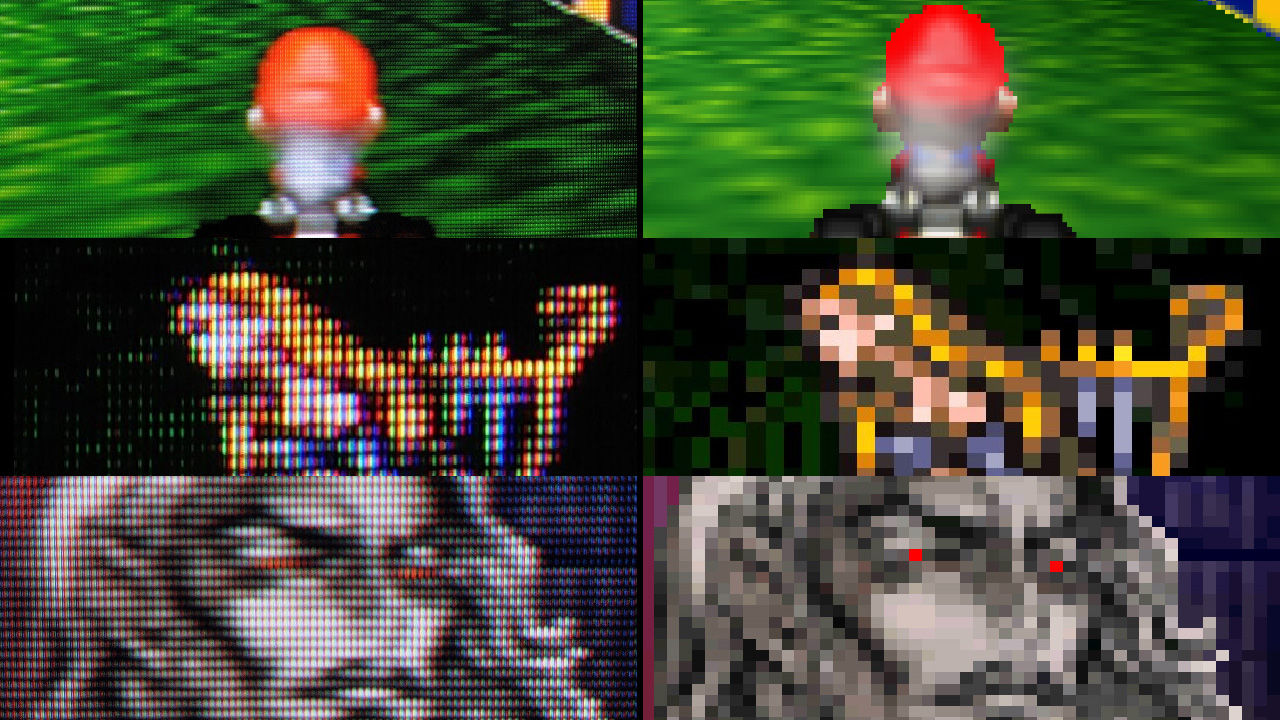
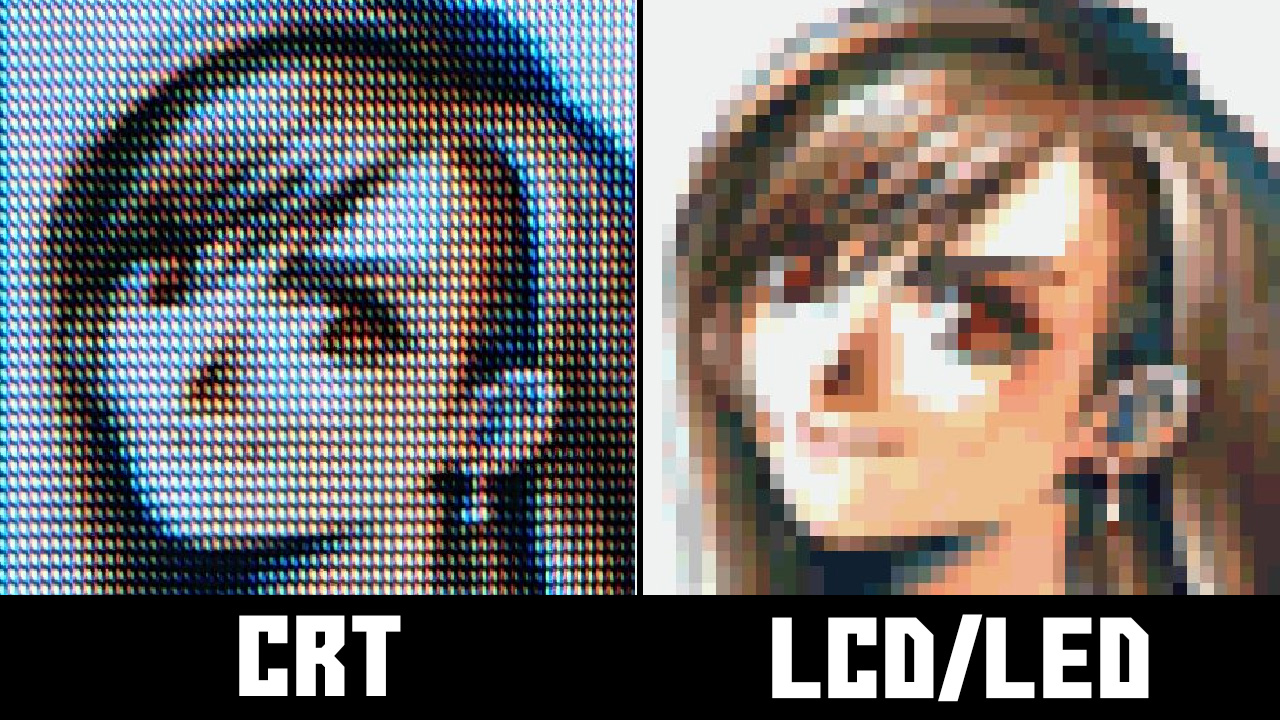
I love the current infatuation with modeling old CRT display systems. Old graphics and videos from the "time before" rely a bit on how those display systems and signals worked in order to make low-color and resolution artifacts look "better" in terms of smoother color gradients and softer edges and diagonals. The shift to modern displays mades everything form that era look blocky and chunky.
The thing that makes this all really "meta-interesting" is that everybody who remembers that time remembers it differently and so there's no "correct" way to do this. We all had different TVs, monitors, different manufactures from different time periods. Some of us played color 16-bit games on tiny black and white TVs, or remember the flicker of the Atari 2600 on a giant RGB front-projection TV.
As a result we have literally thousands of filters like this that try to reproduce or at least model how these old systems looked to give back some semblance of what we remember, even if it's all entirely wrong.
I found after experimenting with a bunch of this that what seems to be more important than all the phosphor glow, scan lines, and shadow mask stuff, is that the display has to be curved for it to finally click with me. And then having reflections of the screen in the bezel are chef's kiss. It's so subtle, but just those two effects alone seem to do more for me personally than the rest.
The Megabezel project is dedicated to what I'm talking about.
It's really striking in action, how the two things (the screen geometry and the bezel reflections) really make it feel like you're looking at a television. At times I completely forget the rest of the giant flat panel even exists.
I've played with Retro Emulators that add screen reflections and scratches and bezels that look like the original artwork on the arcade cabinets, and... I love it.
Notice how the physics of CRT ends up rendering the pixel art the way it was meant to appear. Pixel art was not the final image, the one appeared on the CRT was. You can not make up those details without CRT, shaders should get us there though. I wish this github repo had comparison images like that article.
I'd go a bit further with this claim. Most of what's being done in this space is about inventing new retro aesthetics, not about faithfully approximating how things worked in the 1980s and 1990s. For example, color TVs of that era didn't really have pronounced scanlines. They also didn't have thick, lightly-colored, reflective bezels.
I get that it looks cool and makes old games more aesthetically pleasing. But the reality is that we liked these visuals back then because we had much lower standards, not because CRTs had some magical properties that made the games look awesome.
I used my Atari computers on a black-&-white TV for years until I finally got a Commodore 1702 (JVC)... and it was like looking at candy.
The Atari and that monitor had separate luma & chroma ("S-video") so it was sharper than anything else most people could buy at the time. Most CRT simulators introduce too much degradation by comparison. This one looks pretty good.
> The thing that makes this all really "meta-interesting" is that everybody who remembers that time remembers it differently and so there's no "correct" way to do this.
I suspect it's also because the pictures weren't all that sharp to begin with, the brain filled in ('hallucinated') details. Perhaps more so with young observers.
One side-effect of this is that every time I fire up RetroArch to play a game I spend half an hour looking through every shader and still end up undecided…!


The thing that makes this all really "meta-interesting" is that everybody who remembers that time remembers it differently and so there's no "correct" way to do this. We all had different TVs, monitors, different manufactures from different time periods. Some of us played color 16-bit games on tiny black and white TVs, or remember the flicker of the Atari 2600 on a giant RGB front-projection TV.
As a result we have literally thousands of filters like this that try to reproduce or at least model how these old systems looked to give back some semblance of what we remember, even if it's all entirely wrong.
I found after experimenting with a bunch of this that what seems to be more important than all the phosphor glow, scan lines, and shadow mask stuff, is that the display has to be curved for it to finally click with me. And then having reflections of the screen in the bezel are chef's kiss. It's so subtle, but just those two effects alone seem to do more for me personally than the rest.
The Megabezel project is dedicated to what I'm talking about.
http://www.megabezel.com/